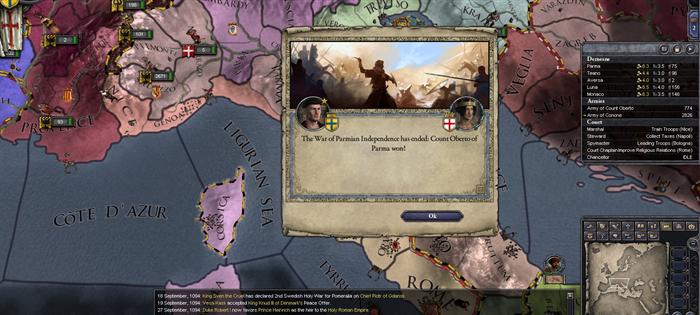
In Part 21 Oberto formalised the Duchy of Salerno by taking the fourth province from the Muslims, swept through Sicily to find it undefended and in turmoil and an old foe rose up with a rebel army. In this part, plots, a rightful heir and the di Parma curse.
It isn’t long before Carla capitulates, realises the error of her ways and sues for peace. When I say peace, I mean the back of a very dark dungeon under Salerno castle
The current Count of Taranto, lovely guy, nothing against him but I don’t think we’re ever going to see eye to eye on religion or culture. He’s got to go.
This week, GARPA has some nifty little strategy games for you to check out.
The Ancient World (Red Raven Games) $21,000 or $15,000, ends 3 April 2014
From the creator of Eight Minute Empire comes a new civ-builder set in the ancient Mediterranean with a box full o’ cards that cover trade routes, combat, knowledge, and building. Red Raven’s artwork is some of the best thematic art on the market, and although it’s a light worker-placement game, it feels like your civilization is rising from nothing to dominate the neighborhood. At $50 for a copy, this is a good deal for a game that’s likely to become a staple of any game group that’s not exclusively grogs. Go see the Kickstarter page and get a load of the game, and some gameplay videos.
In Part 20 Oberto’s cousin and Marshall was unexpectedly given ‘his’ Duchy of Capua, he received many claims on neighbouring provinces, and marched on the Muslims to complete the Duchy of Salerno. In this new part Sicily is found to be falling apart and unhappy subjects rise up.
Oberto’s armies arrive in Taranto to kick out the Muslims. It isn’t much of a match and they’re soon defeated and heading South
Taranto on its own doesn’t give up enough warscore for a victory. Oberto needs to take more Muslim land nearby to bump up the score. Heading South his scouts show the Emperor is already in Sicily, bravely keeping nine Muslims at bay!
Whilst Oberto knocks down the walls of Taranto rebels in Capua decide they’ve had enough and start knocking down its walls.
Kicking off our second “decade” of the long-running Crusader Kings II AAR that you know you love to read.
as always, click images to enlarge
In Part 19 we saw Oberto defeat the pitiful armies of the Duchess of Amalfi, watched the Duchies of Capua and Genoa go up for grabs, and witnessed the King of Sicily lose to the Muslims, thus weakening his realm. In Part 20 Oberto employs the most efficient Chancellor in the Kingdom – ever, gets told off by the Emperor, and realises the errors of his kindness.
Its official, Oberto gets to don the Golden band of Power in all his state photos. Death to the Count, long live the Duke (we get a fancy new flag too)
Oberto considers stripping Carla of her title, but too many vassals will get grumpy, and having just adopted them, now is not the time
There are several reasons why A Distant Plain can be tough to review. That said, they are all the same reasons that make it a compelling game. How many multiplayer wargames have you played where the players are not simply extensions of a team, but rather working at cross purposes as often as not? How many wargames have you played with an elastic time scale? How many wargames eschew anything resembling unit factors or quantified values? And now take all those tweaks and roll them into a single game, and drop into an ongoing conflict whose outcomes are not yet truly determined.
The Story
There are four players: The Coalition, The Government, The Taliban, and the Warlords. Of these, the Taliban are the only one for whom you can draw a reasonably straight line directly from the real life organization in Afghanistan directly to a game role. The Government essentially represents the Karzai administration, but there are game effects that seem to clearly outstrip the existing government’s capabilities. The Coalition is a mix of ISAF, the US, some NGO capabilities, and other external actors attempting to influence actions in Afghanistan. Finally, the greatest amalgam – the Warlords – are the ultimate ‘floater’ faction representing a collection of decidedly non-aligned ‘real’ actors who nevertheless represent a unified set of goals within the mechanics of the game.
The varying scenarios allow you start the war in 2002, 2005, or 2009, but all tend to end around 2013 or so. Obviously, the 2009 scenario is the quickest of them, but any of them will take most of an afternoon, if not more.
The setup for the “surge” scenario, starting in 2009.
Opening the Box
We’ve covered the unboxing before, but to save you jumping to the link, here’s what you get: a solid, 8-panel, mounted, folding map with a ton of useful marginal tracks, boxes, and record-keeping tools; a single sheet of mounted, die-cut counters that are virtually all administrative in nature; a bag of Euro-game-ish markers for the players, representing bases and forces; some dice and pawns; a bunch of plastic bags; the deck of cards used to drive the game along; and a ton of very clear, useful, and well-designed player cards that clearly lay out what players can do on any given turn. Continue reading →