Developer: AGEOD
Publisher: Matrix Games/Slithereine Ltd.
Author: Boggit
Recently, AGEOD created the standalone ancients game Birth of Rome. For players new to the AGEOD ancients world, it is a standalone expansion of their earlier game– see here for my earlier review of the core game. For owners of Alea Jacta Est it is essentially a scenario pack of 6 new scenarios. Boggit takes the Grog’s view of whether it is a “Spoil of War” or just “a collection of broken swords.”
There has been some mixed debate in the Matrix forums regarding the game, with two issues being of greatest concern. Whilst some critics have been a little toxic as to the “value” of the game scenarios, there is reasonable constructive criticism regarding “drive bloat” for existing owners of Alea Jacta Est. The concern here is core game files being duplicated just to play the additional scenarios, so adding unnecessarily to drive space. This isn’t actually as bad as it sounds and a quick email to the developer provided a workable solution, provided here:
Essentially all you need to do is take all the content of the Scens folder of Alea Jacta Est and add it to Birth of Rome, and do the same for the Events folder, then this should be ok. Birth of Rome will then be Birth of Rome + Alea Jacta Est… And you can uninstall Alea Jacta Est afterward (after ensuring that the core Birth of Rome game works)…. Problem sorted!
As to the scenarios, there are six, namely:
- 3rd Samnite War 298BC (104 turns)
- Ager Gallicus 283BC (31 turns)
- Pyrrhic Victories 283BC (70 turns)
- First Punic War 264BC (284 turns)
- First Punic War 256BC (183 turns) (Punic War Lite…? At 183 turns I’m ROFL!)
- Mercenary War 241BC (48 turns)
It must be said that as a game, or scenario pack – depending on whether you are already an owner of the excellent Alea Jacta Est – this early Roman period is rarely seen as a wargame, making this a fresh experience for “Roman Period” gamers.
Unlike previous one off scenario reviews, I’m dealing with six scenarios. To keep this article manageable I’ll summarise each scenario with a bit of background history, a little AAR, together with gameplay observations and my assessment of how the scenario played out both in terms of historical accuracy and as entertainment. Hopefully, that will make the review an easy read, yet give you a fair idea as to what you’re getting for your money if you buy the game.
3rd Samnite War (298-290BC)
The Samnites had fought several earlier wars with Rome for the supremacy of Central Italy. As part of this ongoing struggle the Samnites attempted to ally with the Lucanians. The Lucanians did not agree, so the Samnites attempted to compel them by force. The Lucanians turned to Rome, and drove out the Samnites. In response the Samnites forged more alliances with the Senones (a Gallic tribe), and the Etruscans.
The main Samnite army was commanded by Gellius Egnatius, and Rome’s under L. Scipio Barbatus. At the battle of Cemerinum in 295BC Scipio was defeated. Rome then raised its largest force to date and campaigned against the opposing Italian tribes and Senones in northern Umbria. Gallic forces caused significant Roman losses, but ultimately the Romans prevailed and destroyed the alliance. This resulted in Rome receiving the surrender of the Umbrian rebels, the occupation of the Senones’ territory, and peace with the Etruscans. Having disposed of the allied forces, subsequent campaigns were fought against the Samnites until they sued for peace in 290BC. Ironically for a defeated enemy of Rome the Samnites received citizenship without the vote. The later war against the Senones would not be so considerate… At the end of the Third Samnite War, Rome was pre-eminent in Central Italy and its territory now extended across the peninsula from the Tyrrhenian Sea to the Adriatic.
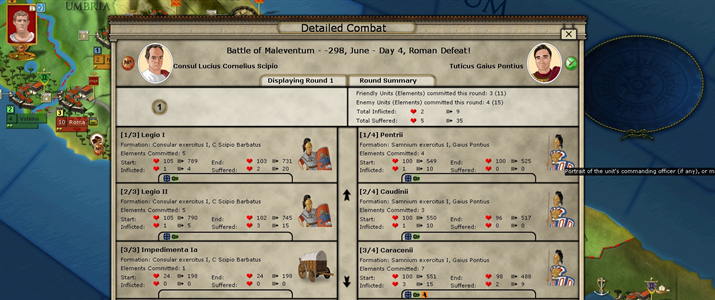
Roman progress is slowed in an early skirmish. Check out the unit artwork… nice.
Continue reading →