Today is not a good day to be defending the Portas and Olympus Passes against the Germans. My unit, the 21st New Zealand Infantry Battalion, has been tasked with defending two tunnels. These tunnels leads directly to the Tempe Gorge. If the Jerries make it there they will succeed in cutting off the Allied withdrawal! We cannot allow that to happen. Intelligence reported that our sector would be quiet, thus leaving us with no dedicated anti-armor units. As usually, military intelligence proved it was not, and we now face a company of Panzer IIs and IIIs without much hope of stopping them.
As the Jerries push forward it became clear we needed to blow at least one of the tunnels. Chances are the other will need to be blown, too. There are still several hours before dark. This is going to be a tough fight.
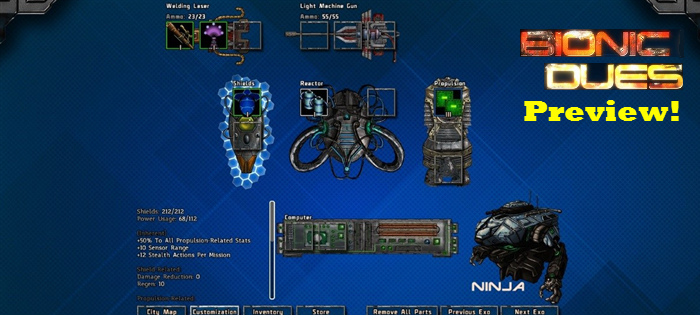
The fact that Arcen Games is so efficient and fast at churning out new games suggests that they might have access to a maniacal AI robot army. But many gamers agree that the chance for that AI army to go rogue and dominate mankind is worth being able to plays games such as the excellent AI Wars series, A Valley without Wind I and II, Shattered Haven, Tidalis, and Skyward Collapse. Now Arcen Games is poised to make a new release tomorrow, October 8 – a Roguelike, turned-based, strategy and RPG game called Bionic Dues. Set in a universe similar to AI Wars, the player is tasked with leading a party of four customizable mechs against a nearly unending mob of nefarious robots.
But Roguelikes are a bit hard to pin down, and I could spend paragraphs describing all of the nuances and options available at the player’s fingers (and there seems to be many, particularly considering the loot system that evokes Diablo ARPG-style loot modifiers and collection). Instead, why not simply SHOW you what the game is like!
So join me on a pictorial AAR as I direct steel melting laser directly into the heart of the AI swarm!
Upon loading up the game, you are greeted with an attractive cityscape. To the left side, the player’s HQ health, player representation, four-bot squad, and store button are show, all displaying extensive and highly descriptive tool-tips at the mere hover of the mouse. To the right is the list of the AI swarm that is inexorably making its way towards my HQ. I have 50 turns (at them point, actually only 46, I’ve done a few missions) to strengthen my forces and weaken theirs before the final battle.
The city scape is also where you choose your missions. Here I am choosing to take on an AI firefight, but I could tear down some barricades impeding my path, strike at an AI-claimed factory, or rescue a capture dignitary.
Before entering the mission, I should probably look at my bots to customize their inventories.
Dr Sterrett is the Deputy Director of the US Army Command and General Staff College’s Digital Leader Development Center’s Simulations & Exercises Division. Yes, that’s a loooooooong title. The short version is: he uses wargames for training, and gets paid for it. He’s also an avid hobby wargamer, and has spent about 7 years struggling to come to grips with the differences between “games” and “simulations” (pretty much since I introduced him to “Brant’s Theory of the Differences Between Games and Simulations”). In spite of this, he agreed to have a chat with us about his role at Ft Leavenworth.
Interview by Brant Guillory, 5 October 2013
The crest of the Command & General Staff College at Ft Leavenworth, KS
Can you please give us an overview of the Digital Leader Development Center’s Simulations & Exercises Division, and what role they fill at the Command and General Staff College (CGSC)?
The Digital Leader Development Center (DLDC) supports CGSC’s exercises. DLDC has three major functions: providing and supporting Army and Joint mission command systems; providing and supporting simulations and exercise planning; and providing an exercise network for the simulations and the command systems.
Thus, Simulations & Exercises Division’s foremost job is exactly what it says on the label: put on the exercises the instructors want: selecting the best simulation for the job, ensuring it is ready to deploy into classrooms, preparing support materials, building scenarios, training student and faculty operators, and providing technical support. In addition, we teach the electives on training with simulations, exercise design, and exercise management; and we conduct R&D to find new simulations to meet the faculty’s needs. Sometimes we build them; we’ve got a very simple board game in testing at the moment, intended to help with classes in planning.
Exterior of the Lewis & Clark Building, that houses the bulk of CGSC
What sort of wargaming backgrounds do your team bring to the table, and how does that help them with their day-to-day jobs?
We’re all gamers. The Euler diagram of the overlap of our gaming hobby interests is pretty complex, and there are very few places where all of us overlap – but there are two keys ones. First, each of us brings some passion for the use of simulations in training and education. Second, all of us enjoy putting on games for other people: things such as building scenarios, designing and testing systems, or creating support materials – exactly the kinds of work we need done.
What’s a “week in the life” of preparing for a big wargaming event (say, a warfighter exercise) look like on the DLDC team? What about a “day in the life” of the actual exercise?
We don’t run anything as big as a warfighter; our biggest exercises are the division exercises. One of these is run for every section of 64 students, and they are run in two big batches: typically 5 or 6 in September, and 16-18 in February. The students use their own classrooms for the exercise. We teach 1 or 2 students from each section to be the technical lead for their section’s exercise. Those students then teach their fellow students how to operate the simulation – in this case, Decisive Action – and are the leads of the Tech Cell during the exercise, while we in Simulations are the on-call tech support.
One of the two Tech Cell students is usually an FA57 officer; Functional Area 57 is Simulation Operations, and one of their primary jobs in the Army is running exercises. Being the Tech Lead is a good experience for them and an opportunity to demonstrate to their peers what it is FA57s do. We usually call the non-FA57s “Temporary FA57s” for the exercise and thus refer to the whole group as FA57s, even though some of them are actually in other branches. Continue reading →
The brehon handed him a hilted weapon, a rare and ancient sword named Hrunting. The iron blade with its ill-boding patterns had been tempered in blood. It had never failed the hand of anyone who hefted it in battle, anyone who had fought and faced the worst in the gap of danger. This was not the first time it had been called to perform heroic feats.
– Beowulf
Devleoper: Fat Shark
Publisher: Paradox Interactive
Author: Jim Zabek
Vikings. What more needs to be said? Traders, raiders, and explorers, for over 300 years they dominated Europe’s imagination, if not their lands. Vikings have always laid a small claim to wargamers’ hearts, and with the heart-pounding new series on the History Channel, Vikings have made a resurgence into mainstream pop culture. Developer Fatshark didn’t miss a beat. Their action game of medieval combat, War of the Roses, grabbed the attention of Grogheads and we stormed into their servers in search of a great game of swordplay. Undaunted, Fatshark considered their next move and (to them) it was obvious: Vikings.
A few weeks ago I interviewed Fatshark’s Gordon Van Dyke and asked him about how the game was developing. Now with early access to the game I’ve managed to get some time behind the keyboard and mouse and see how the game plays myself. I wasn’t disappointed.
For gamers not familiar with first-person medieval action games, their mechanics can be deceptively simple. The player moves his avatar using the standard WASD keys. Moving the mouse changes the view – akin to turning your head or body. Left mouse clicking and dragging in a direction creates a sword thrust. A right mouse click either parries or brings up a shield, depending on the equipment. Using a bow isn’t much more complicated. Right clicking draws the bowstring. Left mouse clicking releases the arrow. As in real life you won’t be able to hold the bowstring for long and after a few seconds if you don’t fire, your avatar will tire and relax his drawn bow to rest.
Yeah, that’s me. Dead. Again.
As with War of the Roses, players have the opportunity to attempt to bandage themselves up and partially heal. They also have the opportunity to attempt to revive fallen comrades or finish off wounded rivals. I say “attempt” because in most cases the action doesn’t quit. You don’t get any “time outs” and while you’re trying to pull off one of these actions, opponents will find you easy prey.
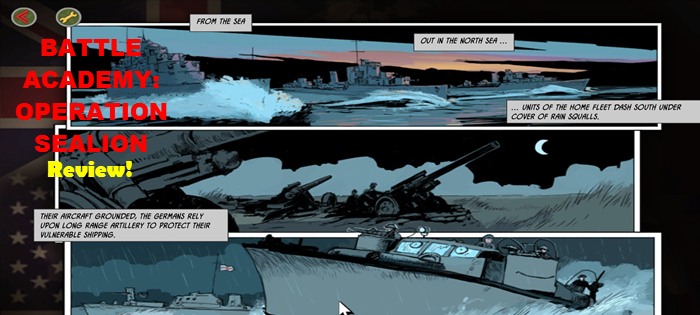
In September 1940, the UK was bracing itself against the prospect of invasion from Nazi Germany. Fortunately, it was called off, largely due to the failure of the Luftwaffe to achieve its goal of air superiority during the Battle of Britain. Battle Academy – Operation Sealion gives us Matrix/Slitherine’s take on what sort of actions might have been fought had Operation Sealion been given the go ahead.
Sitrep, Sir! Jerry’s got the airfield, and we’ve got to get it back. You have regulars, and “Dad’s Army”. Easy, eh?
Battle Academy is a tactical level, turn-based, fast play type wargame. The map is a grid of squares, with each square – if unit ranges are anything to go by – representing some 100 metres across. That at least is what I concluded, as it seemed obvious. I’ve since learned from Jim Zabek that when he wrote the core game review for the Wargamer, Slitherine told him that in fact the ranges were not linear. For some curious design reason each square has a logarithmic variation… Sealion is an expansion to the core game, so this logic likely applies here too. Units are portrayed as single vehicles, guns, with infantry in units of five men, and support weapons like LMG’s and mortars, typically two. There are no specific unit organisations, but in terms of the game scale, I found it easy to rationalise each unit as a representative infantry platoon, or support/tank section.
Gameplay is flexible, with units able to move and fire, in whatever order the player likes. A player can tweak their starting force by spending a limited supply of “force requisition points”, which has the effect of adding variation to the stock scenarios. The rules are simple, yet effective, providing a fun game with a modicum of realism. Off map assets, from artillery to airstrikes are represented, as is unit training, replacements, fresh supplies etc. Vital to game play are the spotting rules, and ambushes from cover represent a real threat. Most of the challenge of the game is in the scenario design rather than the AI. Whilst the AI is not overly challenging – even on the hardest level – the majority of scenarios in Battle Academy – as well as many user made ones – have nasty surprises to trap the unwary, often making good use of the spotting rules. Continue reading →