10/23/13

Tropico 4: Apocalypse – PC Game DLC Review

Developer: Haemimont Games

Publisher: Kalypso

Author: Jim Zabek

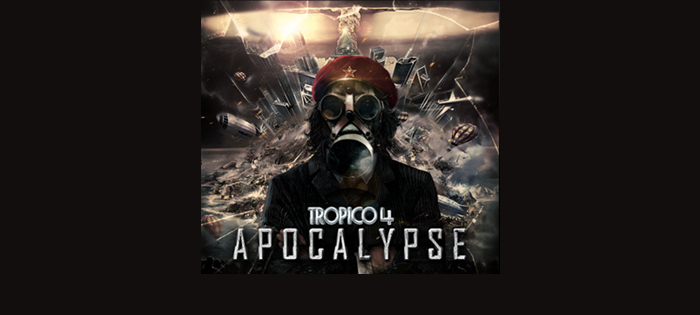
Sandy beaches, tropical islands, piña coladas, tourists, and perky salsa music. No, I’m not day dreaming like the Zac Brown Band, I’m playing Tropico 4’s latest DLC, Apocalypse. Apocalypse offers a single new mission, How I Learned to Love the Bomb, a new skin for El Presidente, a new trait, Survivalist, and a new building, the Fallout Shelter.

Does this hazmat suit make me look fat?

I hadn’t played Tropico 4 in over a year but when the new DLC came out I figured I’d drop $5 for it and see how it treated me.

I loved it. The scenario weighs in at 168% of normal difficulty and it took me all weekend to beat the mission. True to its roots I was faced with all the normal challenges of running a banana republic. Elections are held every 10 years (unless I were to take totalitarian steps against them), my people needed to be fed, sheltered, and their economy managed. The happiness of the various political factions was always hanging in the balance and there was never a point where someone wasn’t unhappy with how I was running things.

But in addition to the normal challenges faced in Tropico 4, the Apocalypse DLC placed me in new and dangerous territory: a tip from Agent Sasha informed me that nuclear war was “imminent.” Her definition of imminent and mine might differ slightly (some decades passed before I was able to win the scenario) but, as will all things Tropican, you can’t take things too seriously. Setting the plot, giving me a plausible sense of urgency, and plopping an extra $30,000 into the Tropican Treasury, my first task was to build the new building, a nuclear bomb shelter. Easy enough. With that out of the way the real work began.

Not the typical news you expect when you take office.

At its surface the objective to win the scenario seems easy: recruit four political factions to join you in the shelter. In practice this is more difficult. Creating policies that make you popular with a particular faction don’t help. Instead you have to accomplish a series of what otherwise might appear to be “optional” tasks. None are particularly easy or cheap.

(SPOILER ALERT)

Continue reading

10/20/13

Total War: Rome II – PC Game Review

Developer: Creative Assembly

Publisher: SEGA

Author: Jim Zabek

Et 2, Roma!

Any time a developer creates a sequel they are faced with a challenge that I call great-more-of-the-same. A sequel presents a major challenge to a successful game. The developer needs to capture the essence of what made the original game great, but needs to offer enough new features and content to make buying the new game worthwhile. Too close of a clone of the original will find gamers sarcastically saying “Great, more of the same :/” On the other hand if a sequel is done well gamers will enthusiastically cry, “Great! More of the same!” Of course, the developer has a third choice, that of making a major departure from the essence of the original game, which case it may not much resemble the original at all.

The Total War series is now venerable. The first game in the series, Shogun, hit store shelves a whopping 13 years ago. Since that time battles have raged across computer landscapes as varied as medieval Europe, ancient Rome, Napoleonic Europe, back to the Sengoku Jidai, and now returning to Rome. That kind of tour-de-force must be respected not only for its breadth but staying power. 13 years is a long haul for any franchise. Given the fickle and demanding expectations of gamers, the ability to consistently and successfully deliver financially successful and critically pleasing titles over that length of time puts Creative Assembly in rarified air.

Diplomacy is better than ever. Here a badly beaten faction offers me a small payment in exchange for peace.

Even more worthy of praise is their ability to create titles set in a historical context which does a decent job of capture historical authenticity. No, the Total War games are not historical simulations. But for AAA titles they manage to bring a lot of history to gamers hard drives and please a lot of historical gamers. Perfect they may not be, but sufficient they are.

When the original Rome: Total War was released it was a significant departure from Shogun and Medieval. A different development team worked on it, and it brought the series fully into the mainstream with a high-quality 3D strategic map, top shelf graphics all the way around, and excellent gameplay. I still remember being haunted by the musical score as I played, and fun as Rome II has been for me, I don’t think its current music lives up to the greatness of the original Rome. A minor quibble, but I do notice such details and wanted to put that marker out there.

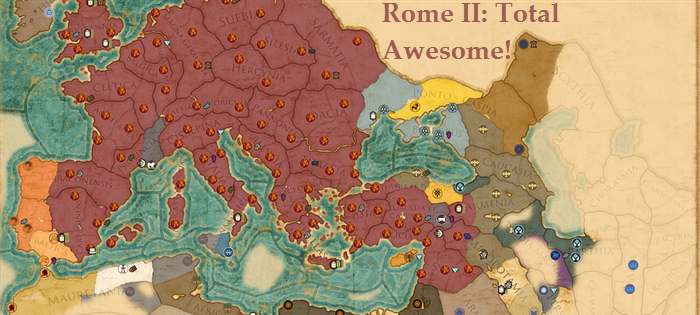
The graphics in Rome II are better than ever.

So when Rome II hit store shelves there was an instant cry among many gamers that it wasn’t the same game. Did Rome II step beyond the great-more-of-the-same category into that dangerous land of unrecognizably different gameplay?

Continue reading

10/17/13

Flashpoint Campaigns: Red Storm – AAR Part 2 of 5

Author: Al Sandrik

Scenario: 11 Bravo

In Part 1 Al took considerable time examining the map and developing a strategy to defend against a Soviet attack. Today in Part 2 he describes the opening moves of the Soviets and how his plan is holding up.

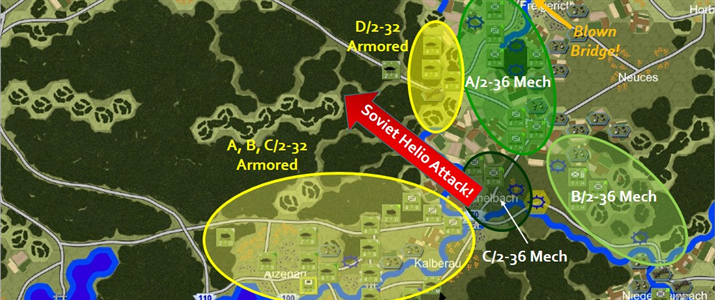
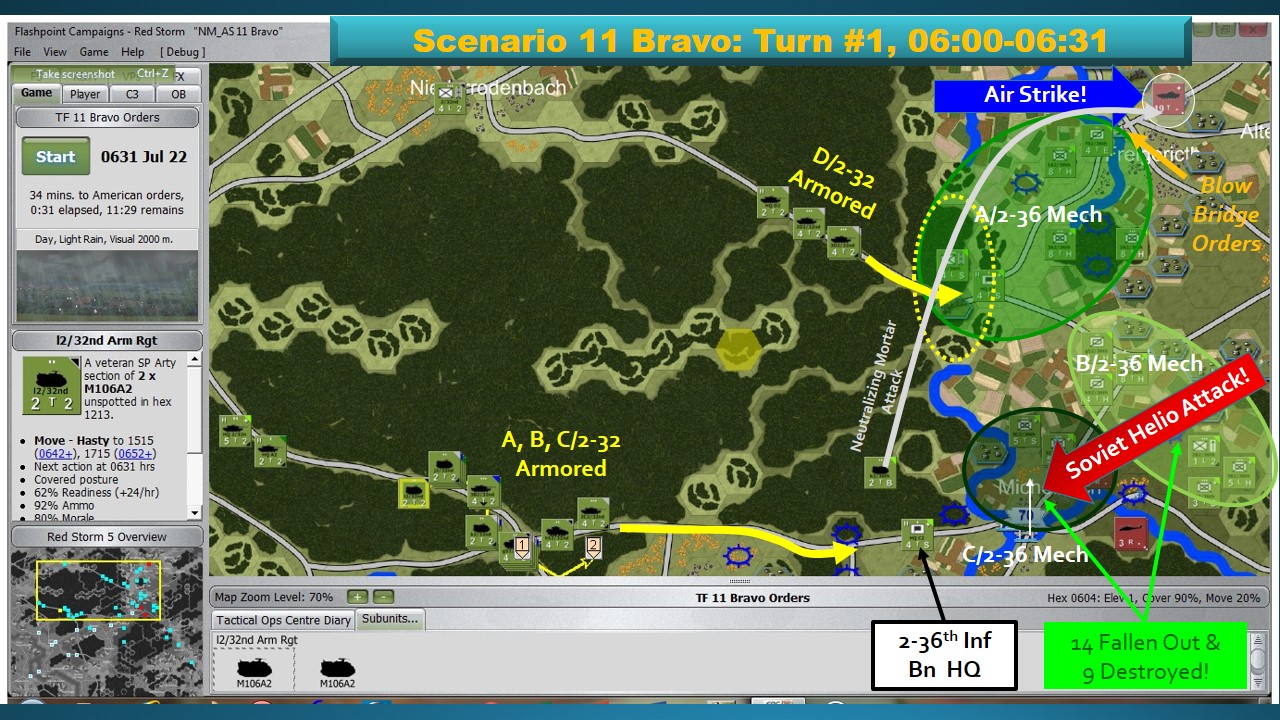
Turn 1 06:00-0631:  Turn 1 started with a few quick surprises!  The first was a Soviet attack helicopter assault that savaged Bravo and Charlie Companies of 2-36!  For about 25 minutes they hit both companies knocking out 23 vehicles/units with 9 destroyed and 14 reported as falling out. It wasn’t totally lopsided exchange as two Mi-24 Hinds were brought down but still very damaging to my position!  Probably the main thing that saved me was heavy rainfall moved in reducing visibility to 500 meters at the height of the fray.  That actually was my second surprise of the turn, if we had maintained 1,500 meter visibility my Forward Air Controllers (FAC) would have been able to call in some F-16s to strike the Soviet units attempting to breach the obstacle belt (figure 18).  Another thing that went wrong was my M106 mortar unit didn’t drop smoke as ordered leaving the Scout unit assigned to blow the bridge exposed. There appeared to be some kind of mix up with the fire orders.

Flashpoint-AAR-Oct-17-Part-2-Figure 18-Turn 1_0600-0631

All of that said some good things happened for me this turn as well. The previously mentioned scout unit attached to Alpha/2-36 did move up to the bridge and began to wire the preset charges.  The OPs safely returned to my lines, and an exchange of fire between 1st Platoon/Alpha Company and the Soviet mechanized unit attempting the breach the obstacles resulted in some Soviet losses.

Elsewhere units from 2-32 Armored Battalion were advancing in good order and were close to assuming their defensive positions.  Overall, concern about the Soviet helicopter battalion continuing to assault my mechanized infantry, and the variable weather/visibilities aren’t helping my cause right now either. Current visibility is 2,000 meters (about 1.25 miles) and if that holds I might try to call in more airstrikes toward 07:00-07:30.

Continue reading

10/11/13

GARPA 29 – GrogHeads Advanced Research on Projects Advisory

By Lloyd Sabin, Brant Guillory, Dan Pinkham, and Jim Zabek
October 11, 2013

The days are really starting to get shorter now. For gamers, that means fewer issues with sunlight reflecting off their monitors and maybe getting the kids to bed a little earlier to get some gaming going. As usual we have some great ideas to make that heavy wallet you’re lugging around a little less cumbersome.

Card Games

Oracle – Mystifying Playing Cards by Chris Ovdiyenko
$9,970 pledged of $20,000 goal, funding ends Friday, November 8

OracleIs there anything more appropriate to this time of year than a card deck based on Ouija boards, spirit photography and spiritualism? Probably, but I can’t think of what it is right now.

Spiritualism was a movement developed between the 1860s and the 1920s that centered on contacting the dead. Initially practiced by American Civil War widows, it gave people hope during the darkest times of their lives and eventually became popular enough and was taken seriously enough for the wealthy and powerful to practice, including a series of American Presidents and politicians. And luckily for printer Chris Ovdiyenko, spiritualism is loaded with instantly recognizable images, as you can see from these screen shots.

For this card deck, the suits will be the big differentiator. Each suit will be unique, with its own theme, whether it is a séance, automatic writing, or ectoplasm. The designs are created by Chris, who etches them onto wood plates with a laser and then applied to “museum quality artist paper.”

It’s a simple but quite interesting project, which is more appropriately shown with images than words. If you’re into the subtly creepy like me (after all, I work here), I think you will appreciate this Oracle card deck. The art is intricate, a bit disturbing and tells many good stories. And while playing cards, a good story can be even more valuable than a good hand. Oracle’s Kickstarter page can be found here.

Oracle1

Miniatures

Reaper Miniatures Bones II: The Return Of Mr Bones!
$1,613,460 pledged of $30,000 goal, funding ends Saturday, October 26

GARPA-29-ReaperOnce or twice each year it seems like a game (or game-related concept) appears on Kickstarter and the internet goes supernova. Last year Reaper Miniatures had that happen to them. They served up a project, asked for a modest $30,000 or $40,000 (I forget exactly) and ended up with gamers literally throwing money at them. When it was all said and done they had well over a million bucks raised and their biggest problem was trying to figure out which building was large enough to hold their inventory until they got it distributed.

Well, lighting has struck twice.

Asking for a modest $30,000, gamers have responded with $1.6 million in pledges and the folks at Reaper are probably starting to consider wallpapering their offices in twenty dollar bills. Kickstarter-ish projects don’t always have a fairytale ending, but if past success is any indication of future results both Reaper and its gamer fan base have some crazy stuff to look forward to. And they lived happily ever after. Until next year, when Reaper will probably do it again. Reaper’s Kickstarter page can be found over here.

Mars Attacks – The Miniatures Game
$250,477 pledged of $50,000 goal, funding ending Saturday, November 10

GARPA-29-Mars-Attacks-MinisThe day before Halloween in 1938 Orson Wells made his famous broadcast that set half of the US East Coast running for the hills. What better time to celebrate a Martian invasion than over the Halloween holiday time? Mars Attacks appears to be (emphasis on “appears” – we have not investigated the issue in any depth) the legitimate representation in game form of the cult-classic movie of the same name.

And, similar to the Reaper Miniatures project above, it has already hit its funding goals and is merrily knocking off stretch goals as gamers toss money their way.

As with most miniature games the figures and scenery are supplied unpainted, but hey, we’re talking about a Martian invasion here. Let your imaginations run free! Unlocked bonuses seem to run the gamut, from additional earthling soldiers to flying saucers to flaming cattle (steak on the hoof for real!).

The designers behind Mars Attacks, Mantic Games, are not newcomers to miniatures gaming. I’ve not played any of their games, but I have seen them in a store and was intrigued. Mars Attacks might be the game to put them on the map and cause gamers to take a second look at all their offerings. In any case, with funding levels already achieved it looks like Mars is indeed going to invade the Earth, and if that sounds like a good time head on over to their Kickstarter page for a closer look.

Continue reading

10/10/13

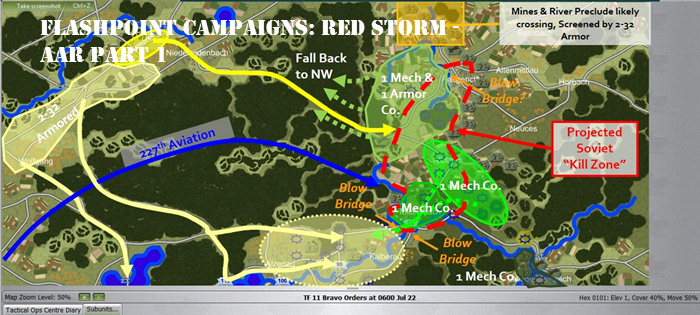
Flashpoint Campaigns: Red Storm – AAR Part 1 of 5

Author: Al Sandrik

Scenario: 11 Bravo

Introduction: My name is Al Sandrik and I have been a Beta Play Tester for Flashpoint Campaigns: Red Storm (FPC:RS) since late June. So with a few months of game play experience under my belt I was asked if I would be interested in preparing an After Action Report for one of the scenarios, an opportunity I jumped at. Before I go into the actual scenario, please let me make a few comments about the game. My experience has been this is a very easy game to get into but one with lots of detail under the hood. I can honestly say I find something new to appreciate and learn with every test run, and I’m sure I will again as I play out this scenario.  We’re going to spend a bit of time with the planning and set up to help you get a feel for the detail included in the game engine. One other quick point, while the game is turn-based, I wouldn’t call it an I Go-You-Go game but rather one where you  assign orders to your subordinate’s and they carry them out during a simultaneous execution phase (WEGO). This is an important point as frequently units don’t move as quickly as you would like and orders aren’t followed as the situation evolves, just like a real world commander experiences!

Scenario: The Scenario I chose is the 11 Bravo scenario primarily because it has a little bit of everything the game has to offer, river crossings, obstacles, free units, fixed units, air strikes, choke points, helicopter units and so much more. The general situation is one where we are in the second day of a Warsaw Pact assault into West Germany. After the 8th Guards Army had broken through at Fulda, Soviet Frontal Aviation units attacked American reinforcements headed into the area with chemical weapons. This caused horrific civilian causalities and delayed the armored units heading in to stem the surging Red tide. How could the Americans buy the reinforcing units time? What resources were available to throw into the breach? It was time to call for the 11 Bravo’s! 11B was the MOS code for combat engineers and those engineers would earn their combat pay.  The 23rd Engineer Battalion Combat was at Hanau, and was tasked to build enough defenses to give the thin line of mechanized infantry a fighting chance before the 79th Guards Tank Division hit their positions.

Game Options: So after choosing the Scenario to play it is time to choose game options.

Figure 1-Scenario Options
These are the options I selected for the scenario.

This is an opt out type of menu so all of the boxes start out checked and you have to remove the checks from the options you don’t want in effect. You can see I have unchecked “Visible Enemy Units” (a Fog of War option), “Limited Staff Rule” and “Allow Browsing of Spotted Enemy Units” (also a Fog of War option). So I suspect the two Fog of War options are pretty much self-explanatory, but what is this “Limited Staff Rule?”  Quite frankly, this rule has a profound effect on the play of the game. Basically, if that box is checked and the Limited Staff Rule is turned off (NOT in effect) the player will be able to assign orders to all units under their command.  Conversely, if the rule is in effect (box unchecked) then the player will only be able to give orders to a limited number of units before electronic jamming and radio communication limitations put a halt to the orders phase.  The basic point here is with the Limited Staff Rule you really need to consider what your highest priorities are during a turn and assign those orders first. This will be important as we play the scenario. A quick side note is when I first start playing with the Limited Staff Rule in effect I thought I was going to hate it, as I am a “Type A” personality and a control freak, but honestly after playing it for just a bit I wouldn’t want to play without it!

Set Up Window: So now that I’ve chosen my options and hit the “Proceed” button I am now taken to the Set Up Window. This is where you have the opportunity to deploy units if not “Fixed” by the scenario designer.

Figure 2-Initial Set Up Screen-Op-Flashpoint-Oct-AAR-Part1
One way you can tell if you are in the “Setup Phase” is the light blue (or light red) shaded hexes indicating places where you may deploy your units.

So as I review my units I can see that one Battalion, the 2-36 Mechanized Infantry Battalion, is actually free and I may (actually must) redeploy those units into the blue shaded hexes. The other battalion in the north, the 2-32nd Armored Battalion, has been fixed by the scenario designer and I will have to take that into account as I develop my strategy and deployment plan. Also note the 11 Bravos (Engineers) have done their job with the obstacles, minefields, and fortified hexes already deployed by the scenario designer. Currently only limited engineering functions (bridging/bridge demolition) are carried out by line units during game play and in the case of scatterable mines, by artillery. This also will be a part of our evaluation and strategy.

So now we need to look at the terrain we will be fighting over. I just don’t do this in the game engine/maps but like to use online Google Maps as well!  First lets look at the map in general:

Figure 3-Game Map North-Flashpoint-Oct-AAR-Part1

Continue reading