12/3/13

Tuesday Screenshot – Red Orchestra 2: Rising Storm

Tuesday-Screenshot-Red-Orchestra-Rising-Storm-2013-12-03_00002

I don’t know where this bridge is. It is a long way from my humble cobbler’s shop on the outskirts of Ruzayevka. We have seized another nameless bridge, crossed another blood-cloggingly cold river, and are trying to drive the Germans out of our land so that we can go back worthless Five Year Plans, endless speeches from Stalin, and bottomless bottles of vodka. All I seek after a long day of fixing soles on shoes that have never stepped in a pool of blood is some hot sausage and kraut, a stiff drink, and a big bosomed woman willing to share my creaky bed. God I hate this war.

11/28/13

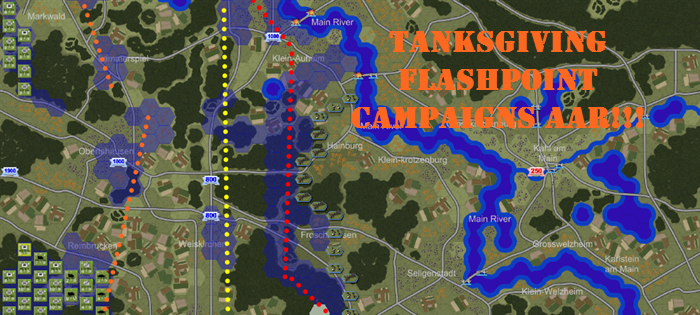
TANKSgiving 2013 – Flashpoint Campaigns: Red Storm AAR Part 1

Scenario: A Test of Wills

Author: Jim Zabek, 28 November 2013

Flashpoint Campaigns: Red Storm has done something for me that no wargame has done for a long time. I am wholly absorbed in it. It’s the only game I want to play. I’ve been addicted to other games (just ask around the forums about Orcs Must Die! 2), but it has been quite some time since a wargame really grabbed me like this. Strange? Perhaps. But there it is.

Normally when I select an AAR I like to choose one I’ve never seen before. It adds to the drama as I don’t know what’s coming and I think it’s a more authentic story to give to an audience. However, With this particular scenario in Red Storm I have played it at least a dozen times and continue to love it. The AI always keeps me guessing. Although I’ve beaten the AI each time I’ve played it, I never feel like I’m winning until after the game is over. The crush of the Soviet horde is hair-raising to the NATO player. The come on almost like a zombie apocalypse: incessant and seemingly innumerable.

In this particular scenario, A Test of Wills, the player is tasked with fending off the Soviets at night. The scenario opens with a heavy rain that limits visibility to 500 meters – one hex. Eventually the rain will lift. But when it lifts can make an enormous difference to the NATO player. In one game it didn’t lift for five and a half hours. As a result the Soviets crawled right into my defensive positions before I could see them, negating my advantage of seeing at night and using ranged weapons like the TOW. I won that scenario, too, but it had me sweating the entire time – I had placed my defensive units in solid overwatch positions to take on the Soviets at range; when they failed to appear I had left some of the roads to the exit points unguarded for an approach in zero visibility. It was probably a worst-case scenario.

In most games the rain lifts sooner – sometimes by the third turn. But the weather isn’t the only thing tossing me curve balls. There are three major avenues of approach for the Soviets. The southern approach has the most victory points and always sees the most action, but the middle of the map also gets a lot of attention, and the northern end sometimes gets heavily tested, too. The AI seems to never do the same thing twice, which keeps this scenario fresh for me every time I play it. And that’s why I keep coming back to this scenario. It’s a mid-sized scenario with lots of uncertainty. So far I’ve won every game I’ve played but I’ve never felt any confidence until the last shot was fired. There simply aren’t enough NATO troops to go around and once their artillery starts to rain too many units get destroyed for anyone to feel confident.

So here I go again. We’ll see what happens.

Continue reading

11/22/13

GARPA 32 – GrogHeads Advanced Research on Projects Advisory

Lloyd Sabin, Brant Guillory, and Jim Zabek, 22 November 2013

Winter is coming. As a blast of cold, icy air descends from the Arctic we here at Grogheads are doing our best to keep your blood hot for some new games and we’re leading off with GMT’s Fields of Fire, which sounds hot even when you read it through the cool glow of your monitor. Don’t miss some other great gaming goodness beyond the Read More link which includes some awesome terrain for sci-fi minis and some remakes of a couple of classic electronic games.

Tabletop Games

Fields of Fire II from GMT Games
Cleared p500 and in final development

Still available at the p500 price of $55, this sequel from GMT Games takes the highly-regarded Fields of Fire series into action with the USMC.  You’ll lead a rifle company through a variety of solitaire scenarios ranging from the WWII PTO through the present day.  A card-driven game with a terrain deck and action deck, Fields of Fire has been described by combat veterans as a pretty damned good representation of the kinds of decisions you need to make in combat.  Check it out here and go place your order with GMT.

Iron&Oakbn1(RBM)


GARPA-Mill

Millennium Wars Advanced: States of Conflict from MCS Group
Still on preorder, no timetable

The Millennium Wars games are an odd fish.  Clearly a map-and-counters wargame that any grog should grok at first glance, but quite complex in the interplay of assets, missions, capabilities, and environmental constraints.  A heavy focus on C4I puts the Millennium Wars series in the forefront of modern conflict simulation, and allows solid modeling of organizational cohesion as well as varied non-combat effects like cyberwarfare and political fallout.  Still on preorder at $49.95, MWA is a package stuffed with a variety of conflicts to make you squirm your way through the difficult decisions faced on today’s battlefields.


ZeppeldromeGARPA-zeppel
$4600 of $35000, project closes 15 December 2013

Steampunks!  Yeah, you!  Wanna race?  Wanna race an airship?  Wanna race and airship and fight dirty?  C’mon, you know you do.  Interchangeable boards, wacky characters, dirty tricks, and lemmings – it’s all here.  Players have modular airships that allow you to mix and match capabilities.  Racecourses change each game, and the deck of dirty tricks looks like a Mario race in the sky.  Put on your brass goggles and silk scarf, float over to Kickstarter to check out a video of gameplay, and plunk down a couple of bucks for a rollicking ride through the sky.

Continue reading

11/9/13

Interview with COL(R) Eric Walters, USMC

This month, we have a fantastic interview with retired USMC Colonel Eric Walters.  Well-known in professional wargaming circles as a supporter for great integration of wargames into training, COL(R) Walters graciously gave us a few minutes of his week to answer some questions and tell some war stories.

Interview by Brant Guillory, 9 November 2013


Can you give us a little bit of your military background in the Marines? And don’t be afraid to get technical – our audience is pretty savvy on organizational details!

I first joined as a tank officer and served as both a tank platoon and an amphibious tractor platoon commander, subsequently serving as a company commander in a maintenance battalion.  I switched my Military Occupational Specialty to serve as a Marine Air Group Task Force Intelligence Officer and I did that job the last 25 years of my career.  In that job I was lucky enough to serve in a wide variety of positions at that tactical , joint task force, subunified and unified command, and national levels.  Most recently I served as the Director of Intelligence for the largest humanitarian assistance/disaster relief operation in the world—the aftermath of the 26 Dec 2004 Indian Ocean tsunami—and as the senior intelligence officer for 3rd Marine Aircraft Wing during the invasion of Iraq in 2003.  One of my bosses at 3d MAW, Charlie Bolden, is presently serving as the Director of NASA, while my wartime commander, Jim “Tamer” Amos, is now Commandant of the Marine Corps.  I guess they somehow succeeded in spite of me!

I did two “wargaming” tours in the military.  One was as the intelligence officer for the II MEF Wargaming Center, basically designing Command Post eXercises (CPX) using computer wargames, manual wargames, and Tactical Exercises Without Troops (TEWTs) where only command posts went to the field to practice combat decisionmaking.  The second was as the intelligence planner for the world’s largest CPX in Korea, ULCHI-FOCUS LENS; my job was writing the exercise scenario, designing the simulation-intelligence system interfaces, and executing intelligence control during the conduct of the exercise.


How did you pick up wargaming as hobby and how did you start to integrate wargaming into your assignments within the Marines?

In 1973 or so I was a young teenage model ship builder and went to a hobby store to purchase yet another 1:700 waterline series plastic kit of a WWII Japanese aircraft carrier when I spied a copy of Avalon Hill’s MIDWAY game.  I bought that instead of the model kit and subsequently became obsessed with wargaming, never building another plastic model ship again.  I used wargaming as a junior officer to teach Marines tactics and was lucky that the institution had its own manual games it employed in training.  In the late 1980s we used a military miniatures game played on molded plastic terrain boards, TACWAR, to teach tactics from company to battalion level.  We had a board game system called STEEL THRUST to exercise regimental and division staffs, played on paper maps.  It took a lot of training and practice to use these wargame-based training devices well.  Far more popular was the computer-assisted CPX supported by the Tactical Warfare Simulation Evaluation and Analysis System (TWSEAS) since it didn’t take a lot of customer unit familiarization training and overhead to use.

COL Walters deep in thought, commanding the Brits at PrezCon 2007
COL Walters deep in thought, commanding the British and Hessians at the Battle of Brandywine at PrezCon 2007

Continue reading