This month, we have a fantastic interview with retired USMC Colonel Eric Walters. Well-known in professional wargaming circles as a supporter for great integration of wargames into training, COL(R) Walters graciously gave us a few minutes of his week to answer some questions and tell some war stories.
Interview by Brant Guillory, 9 November 2013
Can you give us a little bit of your military background in the Marines? And don’t be afraid to get technical – our audience is pretty savvy on organizational details!
I first joined as a tank officer and served as both a tank platoon and an amphibious tractor platoon commander, subsequently serving as a company commander in a maintenance battalion. I switched my Military Occupational Specialty to serve as a Marine Air Group Task Force Intelligence Officer and I did that job the last 25 years of my career. In that job I was lucky enough to serve in a wide variety of positions at that tactical , joint task force, subunified and unified command, and national levels. Most recently I served as the Director of Intelligence for the largest humanitarian assistance/disaster relief operation in the world—the aftermath of the 26 Dec 2004 Indian Ocean tsunami—and as the senior intelligence officer for 3rd Marine Aircraft Wing during the invasion of Iraq in 2003. One of my bosses at 3d MAW, Charlie Bolden, is presently serving as the Director of NASA, while my wartime commander, Jim “Tamer” Amos, is now Commandant of the Marine Corps. I guess they somehow succeeded in spite of me!
I did two “wargaming” tours in the military. One was as the intelligence officer for the II MEF Wargaming Center, basically designing Command Post eXercises (CPX) using computer wargames, manual wargames, and Tactical Exercises Without Troops (TEWTs) where only command posts went to the field to practice combat decisionmaking. The second was as the intelligence planner for the world’s largest CPX in Korea, ULCHI-FOCUS LENS; my job was writing the exercise scenario, designing the simulation-intelligence system interfaces, and executing intelligence control during the conduct of the exercise.
How did you pick up wargaming as hobby and how did you start to integrate wargaming into your assignments within the Marines?
In 1973 or so I was a young teenage model ship builder and went to a hobby store to purchase yet another 1:700 waterline series plastic kit of a WWII Japanese aircraft carrier when I spied a copy of Avalon Hill’s MIDWAY game. I bought that instead of the model kit and subsequently became obsessed with wargaming, never building another plastic model ship again. I used wargaming as a junior officer to teach Marines tactics and was lucky that the institution had its own manual games it employed in training. In the late 1980s we used a military miniatures game played on molded plastic terrain boards, TACWAR, to teach tactics from company to battalion level. We had a board game system called STEEL THRUST to exercise regimental and division staffs, played on paper maps. It took a lot of training and practice to use these wargame-based training devices well. Far more popular was the computer-assisted CPX supported by the Tactical Warfare Simulation Evaluation and Analysis System (TWSEAS) since it didn’t take a lot of customer unit familiarization training and overhead to use.
COL Walters deep in thought, commanding the British and Hessians at the Battle of Brandywine at PrezCon 2007
Next Monday, November 10th, will mark the 38th anniversary of the date the SS Edmund Fitzgerald sank. What does that have to do with this latest installment of GARPA? Not much, as best I can figure, other than that the gales of November seem to have come early again this year. At least around these parts, it’s colder, windier, and wetter than usual and Gordon Lightfoot’s lyrics were ringing in my ears as I sat down to start to pen this edition of GARPA on a Tuesday night. Rest assured we’ll be checking the various crowd-funded sites up until the last hours that we publish – but on a cold fall day it seemed like a good time to start my search for the next column.
Boardgames
Tide of Iron core set & Stalingrad expansion by 1A Games LLC
$9,088 pledged of $22,000 ending November 26th
Back in 2006 Fantasy Flight Games launched Tide of Iron. Set during the Second World War, it was a wargamer’s dream: big maps, lots of minis, and a fun rule system. Now out of print, 1A Games is attempting to bottle some of the magic, but in a smaller box.
Their relaunch of Tide of Iron doesn’t attempt to change the game, but rather enhance it. They are offering tutorial scenarios in a smaller size to help ease players into the game in a more streamlined fashion.
In addition, 1A already has an expansion to Tide of Iron on the way in the form of a Stalingrad game. However, to generate some extra excitement 1A is offering some Kickstarter-exclusive items for the Stalingrad expansion. These include Special Operations cards, Initiative cards, and even exclusive minis such as the sIG 33B. Stretch goals have already been established in case they get overfunded.
With the original Tide of Iron out of print 1A is hoping to sell copies of its game to folks who missed getting in on the action of the original. And players who own the original will have the ability to buy some of the cool new items on an a la cart basis for a modest pledge level. If any of this sounds tempting head over to 1A’s Kickstarter page and check it out.
WARFIGHTER – The Tactical Special Forces Card Game by Dan Verssen Games
$12,841 of $7,000 ending November 27th
Dan Vessen has found a sweetspot on Kickstarter. His Cards of Cthulhu was well overfunded, and that wasn’t his first success. Warfighter launched this week and within three days it was already fully-funded and kicking in the doors of a number of stretch goals with nothing but good stuff to come.
A card-driven game of modern warfare it can be played either solo or with up to six players. It is a cooperative game where players work together to attempt to accomplish missions. Players equip each soldier with a variety of loadouts. Players select a mission randomly which assigns the number of resource points the squad can use. If this sounds familiar to Dan Verssen Games it’s because it is. The technique has been used in other games including Thunderbolt Apache Leader. In Warfighter the player(s) select soldiers and the soldier skills, weapons, and equipment they’ll take with them. Each selection costs a number of resource points to keep the game challenging – you can take everything you want so you have to choose wisely to bring what you need.
The stretch goals have already unlocked campaign rules and bullet-shaped dice. Further goals are hoped to include miniature figures, so players should keep an eye on Warfighter to see what other goodies may be on offer.
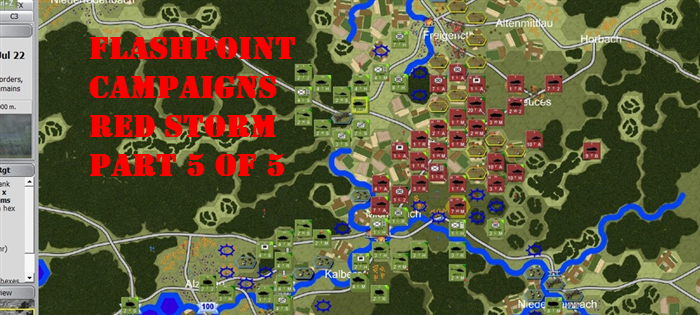
During Part 4 the battle for Michelbach turned into a raging fight. Some badly needed reinforcements arrived in the form of Cobra attack helicopters. Meanwhile my American forces blasted the Soviet attack from three sides. Just as I had identified the position of the Soviet HQ and started to bombard it with artillery the Soviets began to withdraw and the game’s rules kicked in ending the scenario despite the fact that there were still eight hours on the clock.
Turn 8, 09:50-Conclusion: Well my instincts with respect to the Soviet position were good and after a few more rounds flew the Soviet point units began pulling back and the following message was received in Comms (figure 25).
Figure 25
So now that the battle is over how did I do? A review of the Tactical Operations Center (TOC, Figure 26) indicates my defense achieved a 73 percent rating for a “Decisive Success.”
Figure 26
As you could expect the Soviet TOC results (Figure 27) were as lopsided as the American’s with the Soviets suffering a Decisive Loss and loosing 5 Recce, 18 Helo, 78 Tank, 98 APC, 65 Inf, 5 SP AT, 24 HQ, 12 AD and 11 SP Arty enemy subunits.
Figure 27
A finial look at the battlefield before the Soviet began to pull back to more defensive positions (Figure 28)
Figure 28
Conclusions: It is my hope that I was able to both illustrateboth the rich detail in the game and the amount of planning that one can (should) conduct to (successfully) play the game. Like I said, FPC:RS is an easy game to get into but there is a wealth of detail to master. I have found the more thoroughly I plan and analyze the battlefield situation, just as my real world counterparts must, the greater my chances of victory (whether I play as NATO or the Soviets). I would say I personally spend anywhere between one half hour to an hour analyzing the tactical situation and OB/OOB before I even begin to deploy my units. Personally, I enjoy that type of analysis and I hope you enjoy playing FPC:RS as much as I have enjoyed play testing it!
Is there a game that makes you feel like more of a badass than Skyrim? If so I would like to meet it. Look at that shot…it makes me feel Zod-like. Is there anyone within Skyrim to even challenge me?
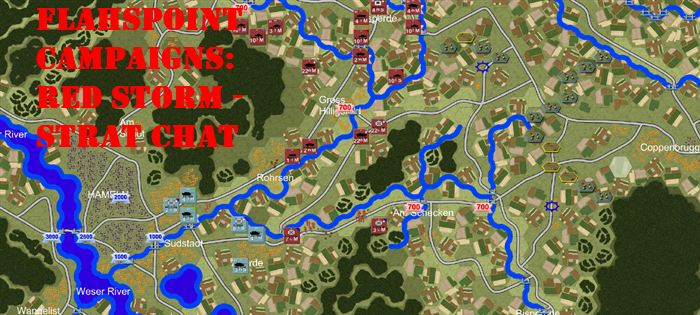
Timing Isn’t Everything, But It Does Help – Flashpoint Campaigns: Red Storm and the OODA Loop
Author: Jim Zabek
“In the loop.”
“Out of the loop.”
We’ve all heard the expression before. But what is “the loop?”
The loop refers to a genius Air Force Colonel by the name of John Boyd. Boyd came up with his OODA loop theory in trying to explain why some pilots had an advantage over others. There is a simple decision process when you’re in a dogfight, and how quickly you can process the information around you, interpret it, and act is vital. Thus the OODA loop was born: Observe, Orient, Decide, Act.
In hindsight OODA seems to be obvious, but it is one of those small obvious things that ends up having big implications. Observing your surroundings, orienting them so you understand what they mean, deciding what to do about them, and acting upon them pretty much describes every decision making process humans make. A quick search of the internet turns up results that suggest a variety of disciplines have adopted the terminology – everything from the military to science to business consulting.
The OODA loop originated in the Air Force, but it was adopted (if not formally at least informally) by the US Army because it was useful in describing how friendly and enemy commanders made decisions about the conduct of battle. The side which could observe, interpret, and act upon the freshest information had a distinct advantage over one that took longer. Troops in the field, of course, observe conditions on the ground immediately. How quickly that information gets passed up through the chain of command is important. Equally important is how quickly that information is processed, a decision is made, the decision passed back down the chain of command, and the troops on the ground take action is vital.
If it takes a colonel of one side fifteen minutes to complete an OODA cycle and it takes the colonel on the other side thirty minutes, then the slower colonel may be ordering troops to do something that was relevant thirty minutes ago instead of right now. That can be a lifetime in a battle of blitzkrieg speeds and deadly Cold War weaponry. An enemy may not be where you thought he was supposed to be because your command cycle is too slow. In a nutshell that’s called “being inside the enemy’s loop.” You’re thinking and processing and acting faster than he is (or he is to you). During the battle of France Rommel’s forces were sometimes called the “Ghost Division” because he was moving so fast that even his own commanders weren’t certain where he was. The name is new. The process is not.
Many Real-Time Strategy games offer hotkeys to allow the player to pump out units as fast as a keystroke. The OODA loop is real-time for both players, and whoever can move through his own OODA loop fastest (and best) will outplay the other player.
Replicating an OODA loop in turn-based games, however, isn’t typically done. Traditionally both sides are given fixed, symmetric turns. They may represent five minutes, one minute, or a say, but traditionally the turns are equal.
A couple of years ago Jim Snyder and I were discussing the OODA loop and the challenge of modeling it in turn-based games. I recall suggesting that turn times be different depending on the speed one side could work through its OODA loop. As events unfolded out that spontaneous conversation qualified me as a playtester for the game.
The estimated command cycle for the West Germans is 31 minutes – the Soviets appear to have only 18 minutes until their command cycle is complete.
Flash forward to today. Flashpoint Campaigns: Red Storm has implemented the OODA loop. In every turn-based game I can remember playing turn times were always symmetrical. Players give orders to units, then a fixed period of time runs. Each player shares an equal amount of time in every turn.
Flashpoint Campaigns: Red Storm has thrown that model out. Instead turn times are variable depending on a number of factors: the amount of EW (Electronic Warfare) hindering your communications, the percent of active HQ units you have active, The percentage of overall subunits you have active, the average unit readiness of your force, and the future command cycle time which can vary according to how many – if any – HQ units you lose in the course of the current turn.
Both friendly and opposition command cycle times are displayed under the C3 tab in the upper right of the screen. I have played games where the Soviets had much shorter command cycles and games where my NATO forces had better command cycles.
During the course of the game I have seen the estimated decisions cycles vary, at one point behind, then ahead of the opfor, only to find that at the end of the turn I had fallen behind again. The key in almost every situation is to keep more of your troops alive and to keep the HQ units alive at all possible costs. There have been times I have found that going “all in” and moving HQ units up to fight has been a good move. However, more often than not keeping them safe was the better move.
When the decision cycles are nearly symmetrical Flashpoint Campaigns: Red Storm plays much like a traditional wargame and players are not likely to notice many differences from other games in terms of how the game plays. However, in cases where the decision cycle is significantly behind the opfor’s I have noticed that my units responded sluggishly to my commands. Orders seemed to take forever to be implemented and when they were events on the battlefield may have evolved to the point where the last order I gave was irrelevant. Delays in orders have been a design feature in some wargames for years, but variable turn length is new. Players will need to anticipate how events on the battlefield will be unfolding and how quickly an opfor with a faster command cycle may be able to react to any plan put in place. Clearly there is also a premium placed on hitting opposing HQ units. The ability to disrupt their function can tip the scales in terms of regaining the initiative in a command cycle.
Sometimes there is nothing that can be done about the state of your OODA loop. Attempting to degrade the opfor’s decision cycle is an important aspect of the overall strategy of winning in Flashpoint Campaigns: Red Storm. Neglecting to take into account the advantage of hindrance it plays in a scenario is done at the player’s peril. It may not be the most important factor leading to victory or defeat, but it can play a substantial role. Enjoying a significant advantage in the decision cycle is a luxury that should be relished. Suffering from a disadvantage in the decision cycle should be a factor in all advanced and contingency plans. The asymmetric turns can be deceptive in how the decision cycle plays out in the game, and it is easy to forget that you may have an advantage or disadvantage until the noticeable difference is too late.