02/21/14

Celtic War Chariots – A Primer

Lloyd Sabin, 14 February 2014

Click images to enlarge

Celt1
Celtic chariot pulled by a team of two

Beginnings and Basics
I wish I could have met the guy who invented the spoked wheel. It’s one of the most vital inventions in the history of mankind. Invented about 4000 years ago, it immediately made all human pursuits easier, from travel to commerce to war. And once the spoked wheel took off, it led directly to the development of the war chariot.

The earliest vehicles built for war and considered chariots were built by the Sumerians, Hittites, and Persians, around 2500 BC. Looking back, we today would probably just call them ‘wagons carrying a spearman’…because that’s exactly what they were. Heavy and cumbersome, with solid wheels, they were not very fast and made for easy targets until the Sumerians developed a more modern two-wheeled version, with the brand new spoked wheels. Speed gave the Sumerians battlefield dominance, and the modern technology of the spoked wheel began to spread.

Simultaneously, wheeled, chariot-like vehicles were being developed all over the world at the time. In the 2000 years before 1AD, examples of chariots appeared, often in a military role, in Chinese, Indian, northern and central European civilizations. The domestication of the horse helped with the advance of chariot technology, especially in European warfare.

Celt3
A spearman mounted on a chariot, doing what he does best.

Perfecting the War Chariot, Inspiring Fear
Of all European cultures of the ancient world, the Celts are probably the best known charioteers, with some of the most feared wheeled vehicles of the ancient era. Not content just scaring the crap out of their opponents with tattoos, woad and war cries, the Celts also tricked out their combat rides with a host of nasty countermeasures that left their opponents reeling. This included scythed wheels, extra noise to spook opposing horses, and skill to jump from the chariot, fight on foot, and jump back on the chariot again to move along without their opponent able to catch up to engage…hit and run tactics at their best. Continue reading →
02/20/14

Prosciutto – Hamming it up with the di Parmas… Part Twenty-Ace

We hit “blackjack” on UCG’s  long-running Crusader Kings II AAR …

as always, click images to enlarge

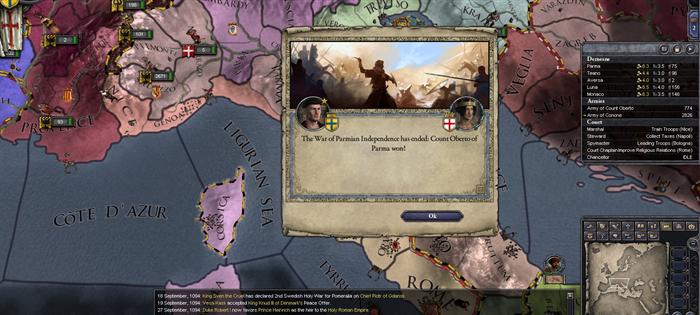
In Part 20 Oberto’s cousin and Marshall was unexpectedly given ‘his’ Duchy of Capua, he received many claims on neighbouring provinces, and marched on the Muslims to complete the Duchy of Salerno. In this new part Sicily is found to be falling apart and unhappy subjects rise up.


 CKii-Pic200

Oberto’s armies arrive in Taranto to kick out the Muslims. It isn’t much of a match and they’re soon defeated and heading South


CKii-Pic201

Taranto on its own doesn’t give up enough warscore for a victory. Oberto needs to take more Muslim land nearby to bump up the score. Heading South his scouts show the Emperor is already in Sicily, bravely keeping nine Muslims at bay!


CKii-Pic202

Whilst Oberto knocks down the walls of Taranto rebels in Capua decide they’ve had enough and start knocking down its walls.

Continue reading →

02/19/14

Companion Reading for Rome 2 – Total War

Looking for some more history in your gaming?  Want to get the backstory on all those pixels you’re pushing around?

Lloyd Sabin – February 10, 2014

Since I was a kid, I have always coupled my gaming with my reading. I think a lot of people do this, but as I have gotten older, it is rare that I read anything that isn’t directly or indirectly tied to what I am currently playing on the PC. Finally, after years of trying to combat this clear OCD-like behavior, I have given up and am going to attempt to do something productive with this quirk.

This first installment is focused on Rome 2: Total War and what I have read, and will be reading, while playing through my Iceni campaign. The Iceni are one of the stronger tribes located in Britannia and the British Isles. In my current campaign I currently hold all of Great Britain, including Ireland, Scotland and Wales, and have made significant progress in northwest Europe, particularly in Gaul. When not attempting to advance on the front and boost Iceni technological and military prowess, I have read the following title, with a few more on deck.

Imperial Governor – The Great Novel of Boudicca’s Revolt by George Shipway

Imperial Governor is the first title I cracked open for companion reading during my Iceni campaign. The title character, Paulinus, is instantly believable as he describes in detail his work in building up Britannia from a backward, swampy outpost to an integral part of the growing Roman Empire. He is a military man through and through, with little patience for insubordination and even less patience for treachery.

Imperial Governor has some great descriptive writing and paints mental imagery of a dark, foreboding, dangerous Britannia, crawling with hostile tribes. Boudicca herself does make a memorable entrance, but because Paulinus does not view her as anything more than scum most details are left out. This book is focused mainly on the Roman response and does it well, guiding the reader through a dense series of battles as well as providing a good order of battle on both sides, including the Celtic tribes aligned with the Iceni and the Roman legions and auxiliaries involved. There are also vivid descriptions of Roman military equipment, architecture and even food, producing a rich historical backdrop for the conflict.

A good part of Imperial Governor also covers Paulinus’ responsibility to both Rome and Britannia once he has put the revolt down, with little mercy. With almost all of Britannia destroyed, it is up to Paulinus to repair the damage, eliminate any remaining threat to Roman power in Britain, and also protect himself and his career from the subsequent fallout. Also keep an eye out for several historical characters with whom you may be familiar, especially if you enjoy Roman history.

Imperial Governor is a blunt and realistic title that doesn’t mince words, just like Paulinus himself. With a cunning, highly intelligent protagonist, some great descriptive writing and excellent battle scenes, George Shipway’s classic proved to be a great companion piece to my Rome 2 Iceni campaign. If interested, the author’s own life makes for some pretty good reading as well. Imperial Governor was his first novel.

Some other titles that I have on the night stand ready to go for more local color include: Continue reading →

02/18/14

Tuesday Screenshot – LNL Heroes of Stalingrad

This week, the Tuesday Screenshot returns with a look at the new Lock’n’Load: Heroes of Stalingrad, in haiku

Click to enlarge

HofS--Go_clear_that_house
Panzers plot their moves
Panic in the Russian ranks!
Will their resolve hold?
Image: Vance Strickland
Haiku: Brant will claim it, if forced at gunpoint

Share your screenshots here >>

02/16/14

Grogheads Interview: The Command – Modern Air Naval Operations Team

Command: Modern Air Naval Operations is one of the most decorated wargames of 2013, including a hard-fought Usenet award, and both of its categories here at Grogheads.  It’s also been one of our most-talked-about games of the past year in our forums.  The guys behind the game took some time to chat with us about where Command came from and where they’re headed next.


So guys, let’s start at the beginning – what was the impetus behind Command, and why did you want to build your own game instead of continuing to build on existing proven platforms?

CMANO-smallCommand is a culmination of all our hobby experiences. Our interest was born reading & watching the great techno-thrillers of our youth (Forsyth, Clancy, Ludlum, Coyle, Brown etc.), absorbing all the political & military history and facets of the Cold War (which at that day seemed far from over) and playing some really great amazing games of the era (F-19, RSR, M1TP, SPI’s CentFront series, the Fleet series, Gunship, Steel Panthers, Fleet Defender, Tornado, Harpoon and loads more). Our involvement with Harpoon and AGSI helped cultivate it as we met each other through the Harpoon community and really started learning about modern warfare, talking with professionals and thinking about simulations. We started out as avid modders for Harpoon 2 and then 3 and had great success helping to grow the Harpoon community and helping AGSI develop their game (including doing the grunt work for their first pro deal).  All of this played a part in our own development and helped us build  a strong and skilled team that had a vision of the game they wanted to build and the energy and motivation to do it. So we reached a point where we really wanted to do our own thing  and as is now self evident we went ahead and did just that.


When you have to describe Command to someone who doesn’t know wargaming, what’s the “elevator pitch” for the game?  How do you hook a potential player with just 1-2 sentences?

If the guy is getting off at the next floor and I have only 5 seconds:

“Command is the ultimate modern air and naval wargamer’s sandbox.”

If we’re both heading for the loft and he’s stuck with me for just a bit more:

“Breakfast – you trade machine gun fire & rocket salvos with pirates & smugglers in the littoral.

Lunch – you plan and execute an Alpha Strike from a carrier.

Dinner – you launch a strategic nuclear attack over the North Pole.

Midnight snack – you spin your own historical or what-if anywhere on the globe, with practically any war machine in existence post-WW2.

All with high realism & accuracy. All in one game. Command.”

Continue reading →