10/20/13

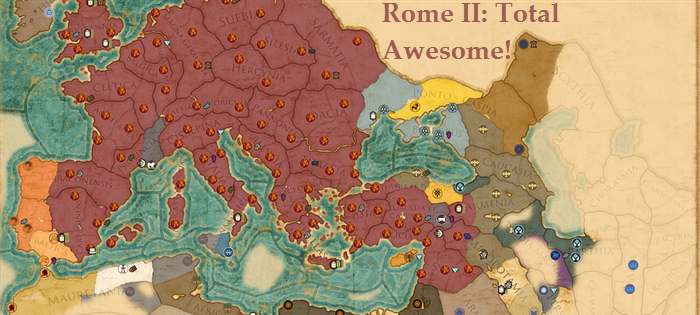
Total War: Rome II – PC Game Review

Developer: Creative Assembly

Publisher: SEGA

Author: Jim Zabek

Et 2, Roma!

Any time a developer creates a sequel they are faced with a challenge that I call great-more-of-the-same. A sequel presents a major challenge to a successful game. The developer needs to capture the essence of what made the original game great, but needs to offer enough new features and content to make buying the new game worthwhile. Too close of a clone of the original will find gamers sarcastically saying “Great, more of the same :/” On the other hand if a sequel is done well gamers will enthusiastically cry, “Great! More of the same!” Of course, the developer has a third choice, that of making a major departure from the essence of the original game, which case it may not much resemble the original at all.

The Total War series is now venerable. The first game in the series, Shogun, hit store shelves a whopping 13 years ago. Since that time battles have raged across computer landscapes as varied as medieval Europe, ancient Rome, Napoleonic Europe, back to the Sengoku Jidai, and now returning to Rome. That kind of tour-de-force must be respected not only for its breadth but staying power. 13 years is a long haul for any franchise. Given the fickle and demanding expectations of gamers, the ability to consistently and successfully deliver financially successful and critically pleasing titles over that length of time puts Creative Assembly in rarified air.

Diplomacy is better than ever. Here a badly beaten faction offers me a small payment in exchange for peace.

Even more worthy of praise is their ability to create titles set in a historical context which does a decent job of capture historical authenticity. No, the Total War games are not historical simulations. But for AAA titles they manage to bring a lot of history to gamers hard drives and please a lot of historical gamers. Perfect they may not be, but sufficient they are.

When the original Rome: Total War was released it was a significant departure from Shogun and Medieval. A different development team worked on it, and it brought the series fully into the mainstream with a high-quality 3D strategic map, top shelf graphics all the way around, and excellent gameplay. I still remember being haunted by the musical score as I played, and fun as Rome II has been for me, I don’t think its current music lives up to the greatness of the original Rome. A minor quibble, but I do notice such details and wanted to put that marker out there.

The graphics in Rome II are better than ever.

So when Rome II hit store shelves there was an instant cry among many gamers that it wasn’t the same game. Did Rome II step beyond the great-more-of-the-same category into that dangerous land of unrecognizably different gameplay?

Continue reading

10/15/13

Tuesday Screenshot – Star Trek

2013-10-15_00006

Captain’s Log – Supplemental:

The Gorn have captured the Helios Device. As their ship escapes with it they have launched a spoiling attack to delay pursuit on our starbase. Commodore Daniels has determined that discretion is the better part of his valor and has fled to his escape shuttle to remove himself from the danger of the Gorn assault. Valorous or not, I cannot abandon the men and women of the starbase. Spock and I have headed to the heart of the Gorn assault and are gradually clearing the mess hall of the attackers. As if that weren’t enough, if the Gorn can unravel the secrets of the Helios Device, their assault on the Federation may be unstoppable.

Captain out.

10/8/13

Tuesday Screenshot – Command Ops: Battles for Greece

Command-Ops-Battles-for-Greece-Oct-8-Screenshot

Today is not a good day to be defending the Portas and Olympus Passes against the Germans. My unit, the 21st New Zealand Infantry Battalion, has been tasked with defending two tunnels. These tunnels leads directly to the Tempe Gorge. If the Jerries make it there they will succeed in cutting off the Allied withdrawal! We cannot allow that to happen. Intelligence reported that our sector would be quiet, thus leaving us with no dedicated anti-armor units. As usually, military intelligence proved it was not, and we now face a company of Panzer IIs and IIIs without much hope of stopping them.

As the Jerries push forward it became clear we needed to blow at least one of the tunnels. Chances are the other will need to be blown, too. There are still several hours before dark. This is going to be a tough fight.


10/4/13

War of the Vikings – First Impressions

The brehon handed him a hilted weapon,
a rare and ancient sword named Hrunting.
The iron blade with its ill-boding patterns
had been tempered in blood. It had never failed
the hand of anyone who hefted it in battle,
anyone who had fought and faced the worst
in the gap of danger. This was not the first time
it had been called to perform heroic feats.

– Beowulf

Devleoper: Fat Shark

Publisher: Paradox Interactive

Author: Jim Zabek

Vikings. What more needs to be said? Traders, raiders, and explorers, for over 300 years they dominated Europe’s imagination, if not their lands. Vikings have always laid a small claim to wargamers’ hearts, and with the heart-pounding new series on the History Channel, Vikings have made a resurgence into mainstream pop culture. Developer Fatshark didn’t miss a beat. Their action game of medieval combat, War of the Roses, grabbed the attention of Grogheads and we stormed into their servers in search of a great game of swordplay. Undaunted, Fatshark considered their next move and (to them) it was obvious: Vikings.

A few weeks ago I interviewed Fatshark’s Gordon Van Dyke and asked him about how the game was developing. Now with early access to the game I’ve managed to get some time behind the keyboard and mouse and see how the game plays myself. I wasn’t disappointed.

For gamers not familiar with first-person medieval action games, their mechanics can be deceptively simple. The player moves his avatar using the standard WASD keys. Moving the mouse changes the view – akin to turning your head or body. Left mouse clicking and dragging in a direction creates a sword thrust. A right mouse click either parries or brings up a shield, depending on the equipment. Using a bow isn’t much more complicated. Right clicking draws the bowstring. Left mouse clicking releases the arrow. As in real life you won’t be able to hold the bowstring for long and after a few seconds if you don’t fire, your avatar will tire and relax his drawn bow to rest.

Yeah, that's me. Dead. Again.
Yeah, that’s me. Dead. Again.

As with War of the Roses, players have the opportunity to attempt to bandage themselves up and partially heal. They also have the opportunity to attempt to revive fallen comrades or finish off wounded rivals. I say “attempt” because in most cases the action doesn’t quit. You don’t get any “time outs” and while you’re trying to pull off one of these actions, opponents will find you easy prey.

Continue reading

09/28/13

The GrogHeads Interview: Jim Snyder & Rob Crandall of Flashpoint Campaigns: Red Storm

fpcrs-boxGrogheads interviews the twin geniuses (geniui?) behind the new Flashpoint Campaigns: Red Storm.


GH: Since the release of Flashpoint Germany it’s been eight years. For wargamers who have been dying to get their hands on the sequel, what took so long?

Rob Crandall: There is researching the game, designing the game, coding the game, testing the game and then documenting the game. Then you decide the original concept wasn’t that great after all and you repeat the process. Keep repeating until you run out of patience and/or money. Such is the carefree life of a game developer! The costs are all upfront and the payoffs are speculative and far away so it is a real test of commitment to see it through to the very end. Worse, although many parts of the work are fun, many are no fun at all and this can really bite. It is easy to zip through the fun parts but it takes discipline to do the rest when you know it will take months and months to do so. Mercifully, I had some outstanding help and the parts that were not so fun for me were picked up by partners who could do them.

I don’t have any direct evidence but I have often thought that for every ten wargames that get talked about only one gets started. For every ten that get started maybe only one gets finished. It is just that hard.

FPRS has almost 200 design documents supporting it, I have 3,500 emails sitting in Outlook regarding it since April 2007 and there are 10,500 forum posts in the Matrix private development forums. At least 100 testers must have helped me out over the years by now. Managing all that takes time too!


GH: Flashpoint Germany used tiles for movement. Flashpoint Campaigns: Red Storm uses hexes. Why the change?

Rob Crandall: I completely rewrote the square tile system so that each tile was broken down into a 4 x 4 grid of cells. Each cell had its own graphic and was rated for all the different terrain factors. The 16 averaged together represented the tile as a whole. It was awesome and very inventive, if I say so myself, but it was still squares and was too different from everything else. Converting the underlying code to hexes took something like a weekend and I have never regretted it. The result was I had to throw away my internal map editor and go to the existing system where we paint a map in a paint program and then scan it for values based on color IDs. That is a little more cumbersome but I loved the look and also loved that it became a chore I could delegate to people with greater graphic talents than I.

Jim Snyder: The graphics fell to me and I’m not really that good compared to a real graphics artist, but what I did does work. Plus folks will be able to mod their own stuff too.

Continue reading