10/24/13

Flashpoint Campaigns: Red Storm – Part 3 of 5

Author: Al Sandrik

Scenario: 11 Bravo

During Part 2, the first turn kicked off with several surprises. A Soviet helo attack inflicted serious damage on Bravo and Charlie companies of 2-36. However, Alpha company managed to set the charges to blow a critical bridge to impede the Soviet advance. The 2-32 armored battalion moved into position in good order. During the second turn Alpha company took heavy fire from the Soviets as they now attempted to blow the bridge, but the arrival of Delta company brought some armor into the fight which quickly dispersed the Soviet mechanized company giving Alpha so much trouble. Let’s see how Turn 3 unfolds.

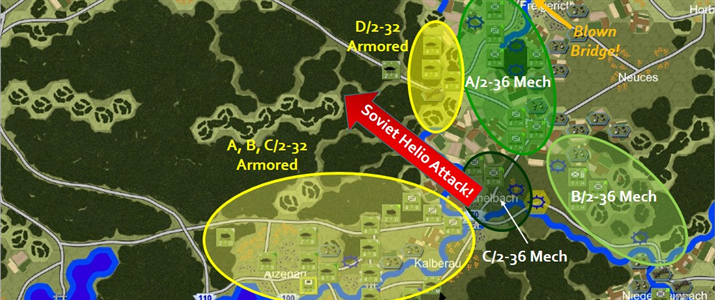
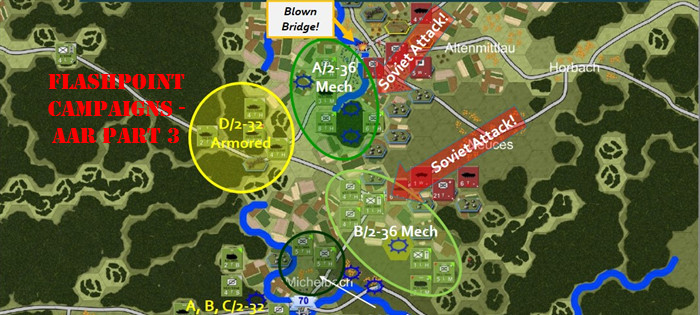
Turn 3, 07:07-07:45: Things continue to go well with the general defensive plan this past 30-45 minutes. The northern Soviet thrust finally cleared two of the obstacle hexes but not before bombardment from friendly SPA M106 mortars and an F-16 airstrike called in by the FAC caused significant enemy casualties. Rather than trying to bridge the blown span their mechanized units turned southwest along the river running right up against one of Alpha Company’s mechanized platoons. With the American mechanized platoon now blocking the route southwestward the over watching Abrams of Delta 2-32 were able to savage the Soviets. Bolstering the defense were several batteries of the 94th Field Artillery (FA) Battalion arrived on the battlefield and hit the thrust with harassing fire. By 07:40 the Soviet lead units were pulling back (Figure 20).

Figure 20.
Figure 20.

Around 07:15 a second Soviet mechanized thrust hit the line of resistance just east of Albstadt. As Bravo Company had been heavily attrited by the earlier helicopter attack this assault was a bit more successful, however one of Bravo Company’s platoons fought a stand up engagement with lead recon and armored elements. As I expected Bravo to be hit hard and planned for them to fall back, I’m not totally surprised but it looks like they will have to fall back to Michelbach earlier than I had planned.
Continue reading →

10/20/13

Total War: Rome II – PC Game Review

Developer: Creative Assembly

Publisher: SEGA

Author: Jim Zabek

Et 2, Roma!

Any time a developer creates a sequel they are faced with a challenge that I call great-more-of-the-same. A sequel presents a major challenge to a successful game. The developer needs to capture the essence of what made the original game great, but needs to offer enough new features and content to make buying the new game worthwhile. Too close of a clone of the original will find gamers sarcastically saying “Great, more of the same :/” On the other hand if a sequel is done well gamers will enthusiastically cry, “Great! More of the same!” Of course, the developer has a third choice, that of making a major departure from the essence of the original game, which case it may not much resemble the original at all.

The Total War series is now venerable. The first game in the series, Shogun, hit store shelves a whopping 13 years ago. Since that time battles have raged across computer landscapes as varied as medieval Europe, ancient Rome, Napoleonic Europe, back to the Sengoku Jidai, and now returning to Rome. That kind of tour-de-force must be respected not only for its breadth but staying power. 13 years is a long haul for any franchise. Given the fickle and demanding expectations of gamers, the ability to consistently and successfully deliver financially successful and critically pleasing titles over that length of time puts Creative Assembly in rarified air.

Diplomacy is better than ever. Here a badly beaten faction offers me a small payment in exchange for peace.

Even more worthy of praise is their ability to create titles set in a historical context which does a decent job of capture historical authenticity. No, the Total War games are not historical simulations. But for AAA titles they manage to bring a lot of history to gamers hard drives and please a lot of historical gamers. Perfect they may not be, but sufficient they are.

When the original Rome: Total War was released it was a significant departure from Shogun and Medieval. A different development team worked on it, and it brought the series fully into the mainstream with a high-quality 3D strategic map, top shelf graphics all the way around, and excellent gameplay. I still remember being haunted by the musical score as I played, and fun as Rome II has been for me, I don’t think its current music lives up to the greatness of the original Rome. A minor quibble, but I do notice such details and wanted to put that marker out there.

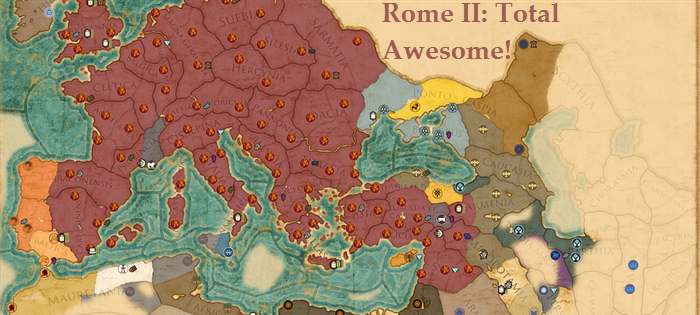
The graphics in Rome II are better than ever.

So when Rome II hit store shelves there was an instant cry among many gamers that it wasn’t the same game. Did Rome II step beyond the great-more-of-the-same category into that dangerous land of unrecognizably different gameplay?

Continue reading →

10/17/13

Flashpoint Campaigns: Red Storm – AAR Part 2 of 5

Author: Al Sandrik

Scenario: 11 Bravo

In Part 1 Al took considerable time examining the map and developing a strategy to defend against a Soviet attack. Today in Part 2 he describes the opening moves of the Soviets and how his plan is holding up.

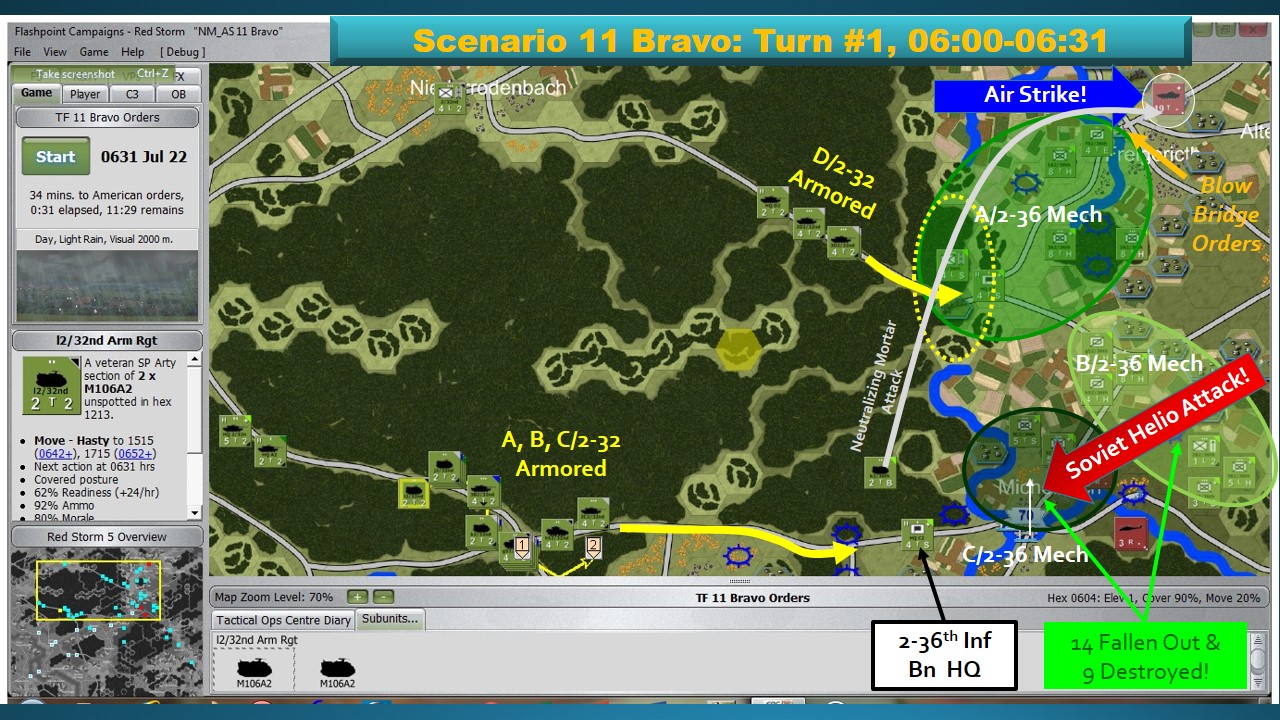
Turn 1 06:00-0631:  Turn 1 started with a few quick surprises!  The first was a Soviet attack helicopter assault that savaged Bravo and Charlie Companies of 2-36!  For about 25 minutes they hit both companies knocking out 23 vehicles/units with 9 destroyed and 14 reported as falling out. It wasn’t totally lopsided exchange as two Mi-24 Hinds were brought down but still very damaging to my position!  Probably the main thing that saved me was heavy rainfall moved in reducing visibility to 500 meters at the height of the fray.  That actually was my second surprise of the turn, if we had maintained 1,500 meter visibility my Forward Air Controllers (FAC) would have been able to call in some F-16s to strike the Soviet units attempting to breach the obstacle belt (figure 18).  Another thing that went wrong was my M106 mortar unit didn’t drop smoke as ordered leaving the Scout unit assigned to blow the bridge exposed. There appeared to be some kind of mix up with the fire orders.

Flashpoint-AAR-Oct-17-Part-2-Figure 18-Turn 1_0600-0631

All of that said some good things happened for me this turn as well. The previously mentioned scout unit attached to Alpha/2-36 did move up to the bridge and began to wire the preset charges.  The OPs safely returned to my lines, and an exchange of fire between 1st Platoon/Alpha Company and the Soviet mechanized unit attempting the breach the obstacles resulted in some Soviet losses.

Elsewhere units from 2-32 Armored Battalion were advancing in good order and were close to assuming their defensive positions.  Overall, concern about the Soviet helicopter battalion continuing to assault my mechanized infantry, and the variable weather/visibilities aren’t helping my cause right now either. Current visibility is 2,000 meters (about 1.25 miles) and if that holds I might try to call in more airstrikes toward 07:00-07:30.

Continue reading →

09/30/13

Battle Academy – Operation Sealion Expansion PC Game Review

Developer: Matrix/Slitherine
Author: Boggit

click images to enlarge

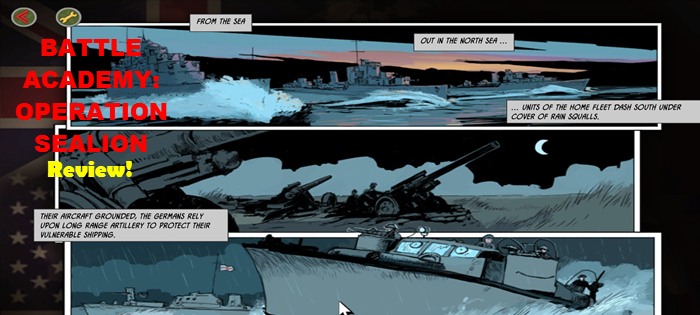
In September 1940, the UK was bracing itself against the prospect of invasion from Nazi Germany. Fortunately, it was called off, largely due to the failure of the Luftwaffe to achieve its goal of air superiority during the Battle of Britain. Battle Academy – Operation Sealion gives us Matrix/Slitherine’s take on what sort of actions might have been fought had Operation Sealion been given the go ahead.

Battle-Academy-Operation-Sealine-Review-Sept-2013-OS1
Sitrep, Sir! Jerry’s got the airfield, and we’ve got to get it back. You have regulars, and “Dad’s Army”. Easy, eh?

Battle Academy is a tactical level, turn-based, fast play type wargame. The map is a grid of squares, with each square – if unit ranges are anything to go by – representing some 100 metres across. That at least is what I concluded, as it seemed obvious. I’ve since learned from Jim Zabek that when he wrote the core game review for the Wargamer, Slitherine told him that in fact the ranges were not linear. For some curious design reason each square has a logarithmic variation… Sealion is an expansion to the core game, so this logic likely applies here too. Units are portrayed as single vehicles, guns, with infantry in units of five men, and support weapons like LMG’s and mortars, typically two. There are no specific unit organisations, but in terms of the game scale, I found it easy to rationalise each unit as a representative infantry platoon, or support/tank section.

Gameplay is flexible, with units able to move and fire, in whatever order the player likes. A player can tweak their starting force by spending a limited supply of “force requisition points”, which has the effect of adding variation to the stock scenarios. The rules are simple, yet effective, providing a fun game with a modicum of realism. Off map assets, from artillery to airstrikes are represented, as is unit training, replacements, fresh supplies etc. Vital to game play are the spotting rules, and ambushes from cover represent a real threat. Most of the challenge of the game is in the scenario design rather than the AI. Whilst the AI is not overly challenging – even on the hardest level – the majority of scenarios in Battle Academy – as well as many user made ones – have nasty surprises to trap the unwary, often making good use of the spotting rules. Continue reading →

09/28/13

The GrogHeads Interview: Jim Snyder & Rob Crandall of Flashpoint Campaigns: Red Storm

fpcrs-boxGrogheads interviews the twin geniuses (geniui?) behind the new Flashpoint Campaigns: Red Storm.


GH: Since the release of Flashpoint Germany it’s been eight years. For wargamers who have been dying to get their hands on the sequel, what took so long?

Rob Crandall: There is researching the game, designing the game, coding the game, testing the game and then documenting the game. Then you decide the original concept wasn’t that great after all and you repeat the process. Keep repeating until you run out of patience and/or money. Such is the carefree life of a game developer! The costs are all upfront and the payoffs are speculative and far away so it is a real test of commitment to see it through to the very end. Worse, although many parts of the work are fun, many are no fun at all and this can really bite. It is easy to zip through the fun parts but it takes discipline to do the rest when you know it will take months and months to do so. Mercifully, I had some outstanding help and the parts that were not so fun for me were picked up by partners who could do them.

I don’t have any direct evidence but I have often thought that for every ten wargames that get talked about only one gets started. For every ten that get started maybe only one gets finished. It is just that hard.

FPRS has almost 200 design documents supporting it, I have 3,500 emails sitting in Outlook regarding it since April 2007 and there are 10,500 forum posts in the Matrix private development forums. At least 100 testers must have helped me out over the years by now. Managing all that takes time too!


GH: Flashpoint Germany used tiles for movement. Flashpoint Campaigns: Red Storm uses hexes. Why the change?

Rob Crandall: I completely rewrote the square tile system so that each tile was broken down into a 4 x 4 grid of cells. Each cell had its own graphic and was rated for all the different terrain factors. The 16 averaged together represented the tile as a whole. It was awesome and very inventive, if I say so myself, but it was still squares and was too different from everything else. Converting the underlying code to hexes took something like a weekend and I have never regretted it. The result was I had to throw away my internal map editor and go to the existing system where we paint a map in a paint program and then scan it for values based on color IDs. That is a little more cumbersome but I loved the look and also loved that it became a chore I could delegate to people with greater graphic talents than I.

Jim Snyder: The graphics fell to me and I’m not really that good compared to a real graphics artist, but what I did does work. Plus folks will be able to mod their own stuff too.

Continue reading →