11/4/13

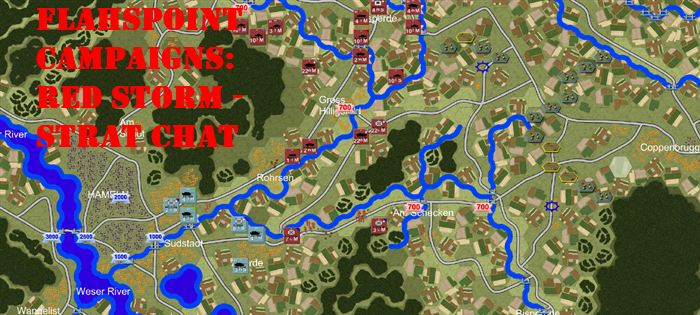
Flashpoint Campaigns: Red Storm – Strat Chat

Timing Isn’t Everything, But It Does Help – Flashpoint Campaigns: Red Storm and the OODA Loop

Author: Jim Zabek

“In the loop.”

“Out of the loop.”

We’ve all heard the expression before. But what is “the loop?”

The loop refers to a genius Air Force Colonel by the name of John Boyd. Boyd came up with his OODA loop theory in trying to explain why some pilots had an advantage over others. There is a simple decision process when you’re in a dogfight, and how quickly you can process the information around you, interpret it, and act is vital. Thus the OODA loop was born: Observe, Orient, Decide, Act.

In hindsight OODA seems to be obvious, but it is one of those small obvious things that ends up having big implications. Observing your surroundings, orienting them so you understand what they mean, deciding what to do about them, and acting upon them pretty much describes every decision making process humans make. A quick search of the internet turns up results that suggest a variety of disciplines have adopted the terminology – everything from the military to science to business consulting.

The OODA loop originated in the Air Force, but it was adopted (if not formally at least informally) by the US Army because it was useful in describing how friendly and enemy commanders made decisions about the conduct of battle. The side which could observe, interpret, and act upon the freshest information had a distinct advantage over one that took longer. Troops in the field, of course, observe conditions on the ground immediately. How quickly that information gets passed up through the chain of command is important. Equally important is how quickly that information is processed, a decision is made, the decision passed back down the chain of command, and the troops on the ground take action is vital.

If it takes a colonel of one side fifteen minutes to complete an OODA cycle and it takes the colonel on the other side thirty minutes, then the slower colonel may be ordering troops to do something that was relevant thirty minutes ago instead of right now. That can be a lifetime in a battle of blitzkrieg speeds and deadly Cold War weaponry. An enemy may not be where you thought he was supposed to be because your command cycle is too slow. In a nutshell that’s called “being inside the enemy’s loop.” You’re thinking and processing and acting faster than he is (or he is to you). During the battle of France Rommel’s forces were sometimes called the “Ghost Division” because he was moving so fast that even his own commanders weren’t certain where he was. The name is new. The process is not.

Many Real-Time Strategy games offer hotkeys to allow the player to pump out units as fast as a keystroke. The OODA loop is real-time for both players, and whoever can move through his own OODA loop fastest (and best) will outplay the other player.

Replicating an OODA loop in turn-based games, however, isn’t typically done. Traditionally both sides are given fixed, symmetric turns. They may represent five minutes, one minute, or a say, but traditionally the turns are equal.

A couple of years ago Jim Snyder and I were discussing the OODA loop and the challenge of modeling it in turn-based games. I recall suggesting that turn times be different depending on the speed one side could work through its OODA loop. As events unfolded out that spontaneous conversation qualified me as a playtester for the game.

The estimated command cycle for the West Germans is 31 minutes - the Soviets appear to have only 18 minutes until their command cycle is complete.
The estimated command cycle for the West Germans is 31 minutes – the Soviets appear to have only 18 minutes until their command cycle is complete.

Flash forward to today. Flashpoint Campaigns: Red Storm has implemented the OODA loop. In every turn-based game I can remember playing turn times were always symmetrical. Players give orders to units, then a fixed period of time runs. Each player shares an equal amount of time in every turn.

Flashpoint Campaigns: Red Storm has thrown that model out. Instead turn times are variable depending on a number of factors: the amount of EW (Electronic Warfare) hindering your communications, the percent of active HQ units you have active, The percentage of overall subunits you have active, the average unit readiness of your force, and the future command cycle time which can vary according to how many – if any – HQ units you lose in the course of the current turn.

Both friendly and opposition command cycle times are displayed under the C3 tab in the upper right of the screen. I have played games where the Soviets had much shorter command cycles and games where my NATO forces had better command cycles.

During the course of the game I have seen the estimated decisions cycles vary, at one point behind, then ahead of the opfor, only to find that at the end of the turn I had fallen behind again. The key in almost every situation is to keep more of your troops alive and to keep the HQ units alive at all possible costs. There have been times I have found that going “all in” and moving HQ units up to fight has been a good move. However, more often than not keeping them safe was the better move.

When the decision cycles are nearly symmetrical Flashpoint Campaigns: Red Storm plays much like a traditional wargame and players are not likely to notice many differences from other games in terms of how the game plays. However, in cases where the decision cycle is significantly behind the opfor’s I have noticed that my units responded sluggishly to my commands. Orders seemed to take forever to be implemented and when they were events on the battlefield may have evolved to the point where the last order I gave was irrelevant. Delays in orders have been a design feature in some wargames for years, but variable turn length is new. Players will need to anticipate how events on the battlefield will be unfolding and how quickly an opfor with a faster command cycle may be able to react to any plan put in place. Clearly there is also a premium placed on hitting opposing HQ units. The ability to disrupt their function can tip the scales in terms of regaining the initiative in a command cycle.

Sometimes there is nothing that can be done about the state of your OODA loop. Attempting to degrade the opfor’s decision cycle is an important aspect of the overall strategy of winning in Flashpoint Campaigns: Red Storm. Neglecting to take into account the advantage of hindrance it plays in a scenario is done at the player’s peril. It may not be the most important factor leading to victory or defeat, but it can play a substantial role. Enjoying a significant advantage in the decision cycle is a luxury that should be relished. Suffering from a disadvantage in the decision cycle should be a factor in all advanced and contingency plans. The asymmetric turns can be deceptive in how the decision cycle plays out in the game, and it is easy to forget that you may have an advantage or disadvantage until the noticeable difference is too late.
09/23/13

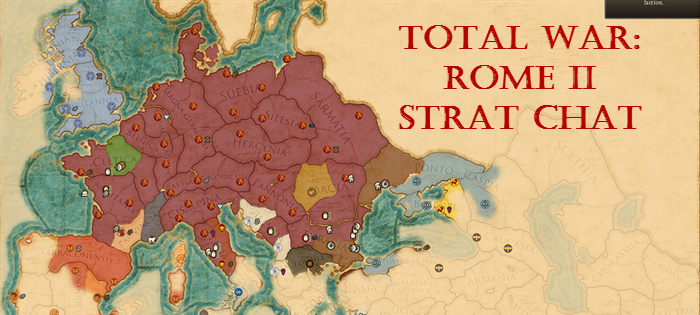
Strat Chat: Rome II

By Jim Zabek

Playing Total War: Rome II can be a challenge. Although there is an in-game encyclopedia it’s fairly limited when you get into the game. It can tell you What things do, but you have to figure out the Why and the When on your own. If ever a game could use a Strategy Guide, this would be it.

I’m now about fifty hours into the game. It’s 79 BC and this is my first campaign. I’m playing the Suebi, northern European Germanic tribesmen, and I’ve managed to conquer most of continental Europe playing on the easiest game mode. Almost universally (at least on our forums) gamers have concluded that even the easiest game setting for Rome II can be challenging. With fifty hours of gameplay into the game, I’m discovering that it finally is relatively easy to play now. I’ve got a surplus of 50,000 gold in my coffers, am making 13,000 gold each turn, have a surplus of about 50 food, and have several large armies trampling about the continent taking provinces by storm at will.

2013-09-23_00011
My empire thus far.

So how did I do it? With only one game under my belt – and that only half completed by my estimate – I cannot claim to be a Rome II guru. However, with some reasonable success I think I can sketch out some basic strategies that may help folks struggling with the campaign. Because there are so many factions and each has their own building I am making a large assumption here: I am assuming that no matter which side you play, infrastructure plays a similar role. I could be wrong on this. If I am, I would urge folks to discuss it in our forums where we all as a community can learn from each other and improve our gameplay. Again, I’m not claiming to be an expert, just a guy with some time to share some thoughts on what I’ve learned so far. With that, let’s begin.

It’s Not All Total War

For a game entitled “Total War” I have found that Creative Assembly has been particularly good about creating games that go well beyond war. The strategy portion of their games has always been the most satisfying to me, and part of my enjoyment comes from the fact that these games incorporate economic and social aspects of empire building along with the military. Rome II is no exception.

2013-09-23_00002
Commerce, culture, and agriculture. These buildings are typical of most of my provinces.

Continue reading

09/9/13

Ranger Up Talks Suicide: An Introduction

This article was originally published September 8th on Ranger Up’s Rhino Den. It is one of seven articles they will publish on the subject over the next week.

By RU Rob

Suicide.

When put together, those seven letters can draw out a range of emotions from fear to anger, sorrow to shame, and everything in between. In recent times suicide has been brought to the forefront of the news within military circles due to the ever increasing occurrence. The sad statistics show that now, more than any other time in our military’s history, our service members are taking their own lives.

So what do we do about it?

There is no easy answer to this question. The stigma that suicide carries with it is one of solitude and secrecy. There is no clear cut answer to solve this problem but I believe the first step is to get people to start openly talking about it, without fear of repercussion.

In the days leading up to Memorial Day, 2013, Blake Powers (Laughing Wolf) from Black Five wrote a powerful article. It really struck a chord with me as I had just lost another friend to suicide. It was then that I decided that if I could rally our writers, we could meet this trend face to face, open the necessary dialogue, and get people talking—the first step in making a difference.

We have rallied and are ready.

What you will read over the next seven days has been three months in the making. The Rhino Den is going to approach this subject the way we do every subject—head on. The writers of The Rhino Den are as diverse as any unit in the military. You will be exposed to perspectives from enlisted and officer; active duty and Veteran; from just about every branch of service and multiple job specialties. We will be providing statistics, personal reflections, and our own thoughts as to why and how this trend is happening.

This is an extremely emotional series for us. Some of our writers faced personal demons in the composition of their pieces and you will experience their pain and anguish. I cannot guarantee that you will agree with everything we will say and, quite frankly, expect to anger a few of you at some point.

There are a few people who deserve mention as we delve into this subject. Karl Monger, Boone Cutler, Deb Boyce, Soldier Hard, and Antonio Centeno are all making huge contributions into the education and fight against suicide. There are many, many other people who are doing great and wonderful things, but I have had direct contact with these amazing people and wish to recognize them as such.

As we begin I hope that you will take the time to share this series with your friends, family, and loved ones. We can only be successful if we keep lines of communication open with each other.


RU Rob

Editor-in-Chief

Ranger Up’s – The Rhino Den

08/20/13

Tuesday Screenshot – Space Hulk

Click to enlarge

screenshot082013


Space Hulk

Suffer not the unclean to live.
Lead us from death to victory,
from falsehood to truth.
Lead us from despair to hope,
from faith to slaughter.
Lead us to His strength and an eternity of war.
Let His wrath fill our hearts.
Death, war and blood;
in vengeance we serve the Emperor
in the name of the Primarch!
In the name of Sanguinius!

Share your screenshots here >>

07/24/13

Star Trek Miniatures

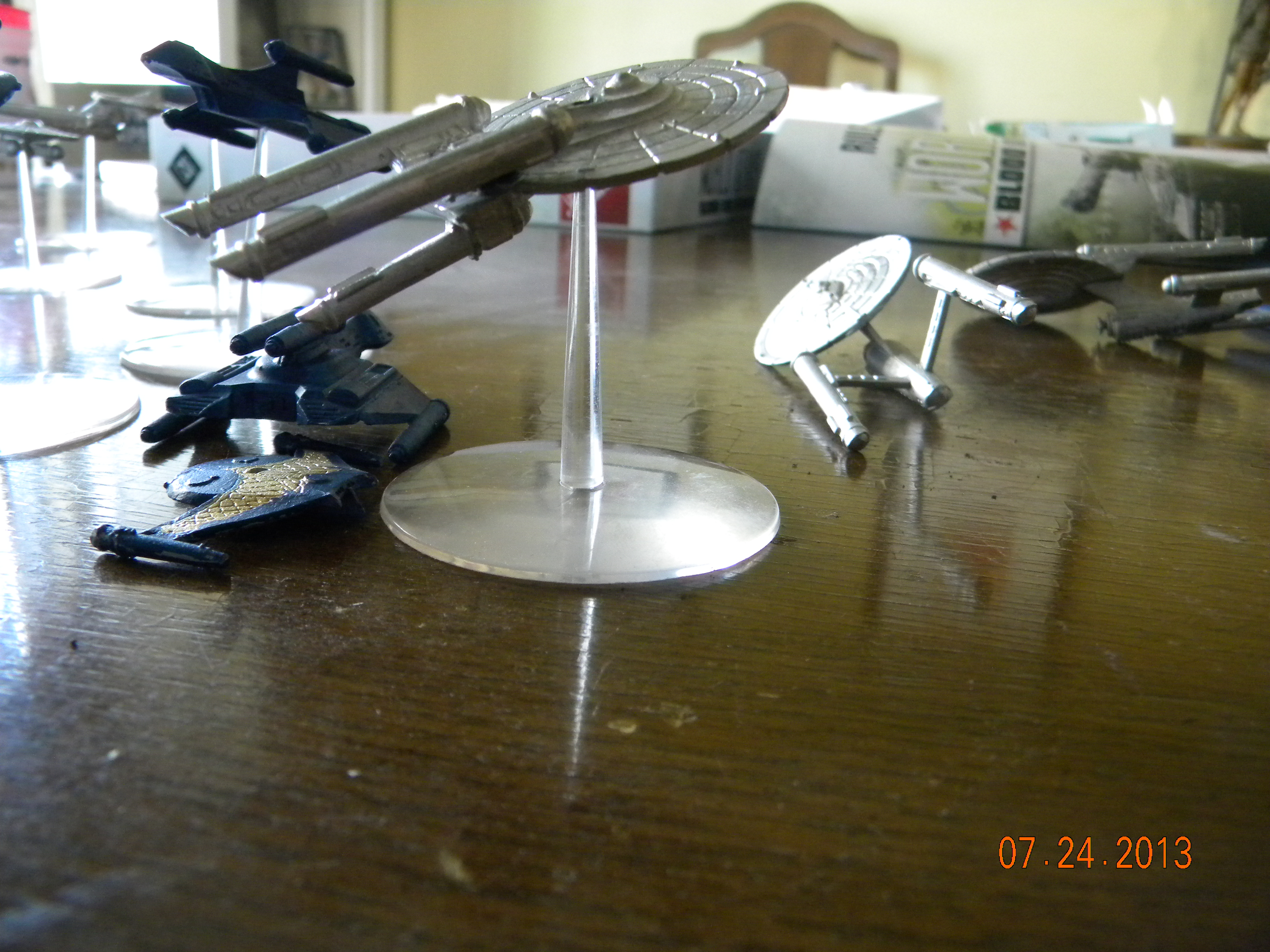
These minis are obviously a work-in-progress, but I wanted to share them. A few months back I bought the recently released Mongoose Publishing’s Romulan Fleet Pack for A Call to Arms. The A Call to Arms miniatures are compatible with other Star Trek gaming systems including Federation Commander. Subsequently I received a couple of booster packs for the Federation and the result is I have a nice collection of both sides with which to field a force.

My preferred primer/paint is Tamiya for these as their Fine Primer goes on like skin and looks like the mini had been cast with the color in it instead of sprayed on.

The Federation ships will be white, but the Romulans can have pretty much any color scheme. The Romulans have twelve houses so the choice of color scheme is pretty open. I have chosen to apply a dark blue base coat, over which I intend to layer some lighter colors to give it some depth.

These images should give a nice indication of the quality of models as well as the direction of painting I’m moving towards. All of the Romulan vessels, with the exception of the Klingon pattern ships, have the Romulan War Eagle traced on their undersides, and Mongoose has indicated that in the future they plan on including the eagle etching on the Romulan owned Klingon vessels.

DSCN2992 DSCN2993 DSCN2994 DSCN2995