02/16/14

Grogheads Interview: The Command – Modern Air Naval Operations Team

Command: Modern Air Naval Operations is one of the most decorated wargames of 2013, including a hard-fought Usenet award, and both of its categories here at Grogheads.  It’s also been one of our most-talked-about games of the past year in our forums.  The guys behind the game took some time to chat with us about where Command came from and where they’re headed next.


So guys, let’s start at the beginning – what was the impetus behind Command, and why did you want to build your own game instead of continuing to build on existing proven platforms?

CMANO-smallCommand is a culmination of all our hobby experiences. Our interest was born reading & watching the great techno-thrillers of our youth (Forsyth, Clancy, Ludlum, Coyle, Brown etc.), absorbing all the political & military history and facets of the Cold War (which at that day seemed far from over) and playing some really great amazing games of the era (F-19, RSR, M1TP, SPI’s CentFront series, the Fleet series, Gunship, Steel Panthers, Fleet Defender, Tornado, Harpoon and loads more). Our involvement with Harpoon and AGSI helped cultivate it as we met each other through the Harpoon community and really started learning about modern warfare, talking with professionals and thinking about simulations. We started out as avid modders for Harpoon 2 and then 3 and had great success helping to grow the Harpoon community and helping AGSI develop their game (including doing the grunt work for their first pro deal).  All of this played a part in our own development and helped us build  a strong and skilled team that had a vision of the game they wanted to build and the energy and motivation to do it. So we reached a point where we really wanted to do our own thing  and as is now self evident we went ahead and did just that.


When you have to describe Command to someone who doesn’t know wargaming, what’s the “elevator pitch” for the game?  How do you hook a potential player with just 1-2 sentences?

If the guy is getting off at the next floor and I have only 5 seconds:

“Command is the ultimate modern air and naval wargamer’s sandbox.”

If we’re both heading for the loft and he’s stuck with me for just a bit more:

“Breakfast – you trade machine gun fire & rocket salvos with pirates & smugglers in the littoral.

Lunch – you plan and execute an Alpha Strike from a carrier.

Dinner – you launch a strategic nuclear attack over the North Pole.

Midnight snack – you spin your own historical or what-if anywhere on the globe, with practically any war machine in existence post-WW2.

All with high realism & accuracy. All in one game. Command.”

Continue reading

12/23/13

Games for the Holidays

GrogHeads Writing Staff, 23 December 2014

We asked our writing crew to recount their favorite holiday game gift memories.  See if you can guess who they are, and discuss your favorite holiday game gift hauls here >>

My first PC was a clone 486 DX-33 in a full tower, steel ATX case. I loved that 35 pound beast – it was my first PC gaming platform. After I played the obligatory Wolfenstein 3D, I wanted to try something different, like a flight sim. As luck would have it, Christmas was right around the corner and Santa was prepared to rock my world. On Christmas morning, I opened my gifts, which included a game called Comanche Maximum Overkill by Novalogic. By today’s standards, the game was very pixelated and had a laughable flight model, but I must have played that game from start to finish at least four times.  The joy of pounding T-72’s and SAM sites with Hellfire missiles and Hydra rockets while the snow gently fell outside my computer room window was perfection. Comanche made great use of my 4 MBs of RAM and kick-ass, 1MB Trident video card. As the years began to roll by, I started playing study sims with better graphics and more realistic flight models, but it all started with that Christmas back in 1992 and a copy of Comanche Maximum Overkill.

For Christmas 1984 I received a Nintendo NES. You’d think a 14-year-old kid would be beside himself for such a present, and I was, but my biggest ‘score’ wasn’t that game system. Instead, it was my copy of Axis & Allies that my mother bought for me. I broke it out right then and there on the floor and proceeded to play it by myself, while listening to the KISS cassette tape (another Christmas gift for that year) – Animalize. Don’t judge, it was 1984, man. Anyway, that was my first ‘cool bits’ game that didn’t have hexagons or cardboard counters to push around. A part of me, the anal grog part, might have railed against such a travesty (the side of me that loved Third Reich was not happy at that moment), but you can’t beat a classic game like A&A. Well…actually, you CAN beat that, because that very same Christmas, my grandmother bought me a late Christmas gift…a copy of Axis & Allies. By then I’d learned to not like stacks of chips and preferred masses of units stuffed into provinces…and two copies satisfied my OCD need to do just that! When my mother told me we needed to return that second copy, I insisted that there was little chance of that happening!

I was 12 and the only thing on my list that year was the Axis and Allies boardgame; the classic version as they had yet to come out with the theatre specific versions.  I had been brielfy exposed to the game at a friend’s house earlier in the year and since then that was all I had talked about.  I clearly remember people asking me what A&A was, and I would reply, “its like Risk but on steriods and in WWII!”  Needless to say, tucked in amongst the gifts surrounding the Christmas tree that year was a giant box with my name on it.  For two weeks it sat there under that tree calling to me, mocking me, tempting me.  Finally Christmas morning arrived and true to form my dad, with a chuckle in his voice, informed me that the big box was the last present to be opened after everyone had opened all the others.  I couldn’t tell you what anyone else got that year much less what other presents I recieved, all I knew was that A&A would finally be mine.  Sure enough the time came and I ripped into the giant present with reckless abandoned.  There it was, nice and shiny in the shrink wrap, my first “wargame.”  As you can imagine I did not move from that spot the rest of the day, save for dinner.  I read straight through the rule book, set the board up and then since no one would play with me, began my first solo wargaming experience until I was forced to go to bed that evening.  While admittedly I have recieved bigger and better wargame related gifts since then this memory has to be one of my favorites.

Christmas of 1982 was a games-overload Christmas for me.  We were in the midst of moving from Ft Ord, CA to the Armed Forces Staff College in Norfolk, VA, so there was a limit to how much “stuff” my parents wanted to haul around for us kids for Christmas gifts.  While we were living in California, I had discovered RPGs with some classmates, and I already had a handful of different D&D books, but my Christmas wish list was full of them.  There were also a handful of wargames on there, but that was mostly to fill up the list in the hopes that no one would buy me more socks that year.  We spent Christmas with grandparents in Louisiana on our trip across the country, and between the two different places, that year I unwrapped the AD&D Dungeon Master’s Guide, the AD&D Dieties and Demigods book, and a few of the old candy-stripe modules (I got several, but U1 is the only one I specifically remember from that Christmas).  Oh yeah, and there were wargames, too!  I got the old generic “Battle!” from Yaquinto, and Avalon HIll’s “War and Peace”.  Not a bad haul for a 5th-grader!  Several years later I scored module B10, the Dragonlance Campaign hardcover, a Battletech boxed set, and Star Frontiers Knight Hawks all in one Christmas, but by then the bar had been set pretty high with the “Haul of ’82”.

As I look back over an ever-increasing number of Christmases I’ve celebrated and reflect upon the games I’ve received as gifts I can’t point to a single “greatest” game that I’ve received. Instead, my favorite part is the a process, but let’s call it something less dry – the spirit of giving. Many years ago my best friend and I agreed to exchange games for Christmas. Not tools. Not sports paraphernalia. Games. I’m not particularly knowledgeable about fine art, but some time back I ran across a story where an interviewer asked Picasso what his favorite painting was. His reply: “The next one.” So it is with me. I’ve gotten some great gifts over the years (and given some great ones, too). But for me the best gift is knowing that we have a tradition where we know that next year, we’ll get at least one game from someone who knows games and can even play them.

Tell us what you think in the forums >>

12/14/13

Spearpoint 1943, Kickstarter Preview and Interview with Designer Byron Collins

Byron Collins has launched a new Kickstarter campaign for the Spearpoint 1943 system, and is closing fast on his funding.  He took a few minutes out of his busy days pimping this excellent card-driven WWII game to, well, to continue pimping it, but with GrogHeads!

Brant Guillory, 14 December 2013


Give us 3 words to describe Spearpoint 1943 as a game system.

Quick, Fun, Deep

S43INT-Spearpoint1943MapExpansionPlay2

OK, now give us the short paragraph – what’s special about the way Spearpoint 1943 plays, and where are wargamers likely to fit this into their staple of wargames?

Spearpoint 1943 is an expandable card game at its core (non-collectible).  It’s highly portable with its small box and small footprint of play.  It’s quick, deep, and keeps players interested because as you play, the game really tells a story.  For players who want even more depth than just playing with cards, they can optionally expand it with the Village and Defensive Line Map Expansion that got a 2013 Origins Award Nomination for Best Historical Boardgame.  The Map Expansion adds terrain boards that set up differently each game- it really changes the game and takes it even deeper- offering new challenges to Spearpoint players.  It’s a very scalable system.  Spearpoint fits nicely into a gamer’s library who seeks a great fast filler that’s easy to teach (even to teenage sons/daughters), yet scratches that tactical itch without drowning players in minutia.  It’s also been called an excellent ‘filler’ game between larger wargames.

What was the genesis behind Spearpoint 1943 and what were some of the design challenges you experienced along the way?

Spearpoint 1943 came about at WBC one year.  I was trying to demonstrate my very first design, which was much more complex (Frontline General: Italian Campaign Introduction).  I didn’t have time to show such a complex game, so focused on demonstrating just one element of it- combat.  From there, Spearpoint was born.  After honing the game to be a standalone card game, the combat system became even better and more fun.  Breaking it out of my first game made me realize that everything else I had done with that original design wasn’t quite as fun as just focusing on the combat.  The original Spearpoint 1943 is my best-selling game, was my first game in distribution, and remains popular- hence the expansions and new standalone game- Spearpoint 1943 Eastern Front. Continue reading

11/9/13

Interview with COL(R) Eric Walters, USMC

This month, we have a fantastic interview with retired USMC Colonel Eric Walters.  Well-known in professional wargaming circles as a supporter for great integration of wargames into training, COL(R) Walters graciously gave us a few minutes of his week to answer some questions and tell some war stories.

Interview by Brant Guillory, 9 November 2013


Can you give us a little bit of your military background in the Marines? And don’t be afraid to get technical – our audience is pretty savvy on organizational details!

I first joined as a tank officer and served as both a tank platoon and an amphibious tractor platoon commander, subsequently serving as a company commander in a maintenance battalion.  I switched my Military Occupational Specialty to serve as a Marine Air Group Task Force Intelligence Officer and I did that job the last 25 years of my career.  In that job I was lucky enough to serve in a wide variety of positions at that tactical , joint task force, subunified and unified command, and national levels.  Most recently I served as the Director of Intelligence for the largest humanitarian assistance/disaster relief operation in the world—the aftermath of the 26 Dec 2004 Indian Ocean tsunami—and as the senior intelligence officer for 3rd Marine Aircraft Wing during the invasion of Iraq in 2003.  One of my bosses at 3d MAW, Charlie Bolden, is presently serving as the Director of NASA, while my wartime commander, Jim “Tamer” Amos, is now Commandant of the Marine Corps.  I guess they somehow succeeded in spite of me!

I did two “wargaming” tours in the military.  One was as the intelligence officer for the II MEF Wargaming Center, basically designing Command Post eXercises (CPX) using computer wargames, manual wargames, and Tactical Exercises Without Troops (TEWTs) where only command posts went to the field to practice combat decisionmaking.  The second was as the intelligence planner for the world’s largest CPX in Korea, ULCHI-FOCUS LENS; my job was writing the exercise scenario, designing the simulation-intelligence system interfaces, and executing intelligence control during the conduct of the exercise.


How did you pick up wargaming as hobby and how did you start to integrate wargaming into your assignments within the Marines?

In 1973 or so I was a young teenage model ship builder and went to a hobby store to purchase yet another 1:700 waterline series plastic kit of a WWII Japanese aircraft carrier when I spied a copy of Avalon Hill’s MIDWAY game.  I bought that instead of the model kit and subsequently became obsessed with wargaming, never building another plastic model ship again.  I used wargaming as a junior officer to teach Marines tactics and was lucky that the institution had its own manual games it employed in training.  In the late 1980s we used a military miniatures game played on molded plastic terrain boards, TACWAR, to teach tactics from company to battalion level.  We had a board game system called STEEL THRUST to exercise regimental and division staffs, played on paper maps.  It took a lot of training and practice to use these wargame-based training devices well.  Far more popular was the computer-assisted CPX supported by the Tactical Warfare Simulation Evaluation and Analysis System (TWSEAS) since it didn’t take a lot of customer unit familiarization training and overhead to use.

COL Walters deep in thought, commanding the Brits at PrezCon 2007
COL Walters deep in thought, commanding the British and Hessians at the Battle of Brandywine at PrezCon 2007

Continue reading

10/5/13

Interview with Dr James Sterrett, US Army Command and General Staff College

Dr Sterrett is the Deputy Director of the US Army Command and General Staff College’s Digital Leader Development Center’s Simulations & Exercises Division.  Yes, that’s a loooooooong title.  The short version is: he uses wargames for training, and gets paid for it.  He’s also an avid hobby wargamer, and has spent about 7 years struggling to come to grips with the differences between “games” and “simulations” (pretty much since I introduced him to “Brant’s Theory of the Differences Between Games and Simulations”).  In spite of this, he agreed to have a chat with us about his role at Ft Leavenworth.

Interview by Brant Guillory, 5 October 2013

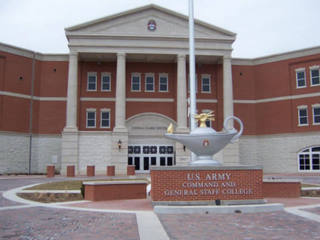
The crest of the Command & General Staff College at Ft Leavenworth, KS

Can you please give us an overview of the Digital Leader Development Center’s Simulations & Exercises Division, and what role they fill at the Command and General Staff College (CGSC)?

The Digital Leader Development Center (DLDC) supports CGSC’s exercises.  DLDC has three major functions: providing and supporting Army and Joint mission command systems; providing and supporting simulations and exercise planning; and providing an exercise network for the simulations and the command systems.

Thus, Simulations & Exercises Division’s foremost job is exactly what it says on the label: put on the exercises the instructors want: selecting the best simulation for the job, ensuring it is ready to deploy into classrooms, preparing support materials, building scenarios, training student and faculty operators, and providing technical support.  In addition, we teach the electives on training with simulations, exercise design, and exercise management; and we conduct R&D to find new simulations to meet the faculty’s needs.  Sometimes we build them; we’ve got a very simple board game in testing at the moment, intended to help with classes in planning.

Exterior of the Lewis & Clark Building, that houses the bulk of CGSC

What sort of wargaming backgrounds do your team bring to the table, and how does that help them with their day-to-day jobs?

We’re all gamers.  The Euler diagram of the overlap of our gaming hobby interests is pretty complex, and there are very few places where all of us overlap – but there are two keys ones.  First, each of us brings some passion for the use of simulations in training and education.  Second, all of us enjoy putting on games for other people: things such as building scenarios, designing and testing systems, or creating support materials – exactly the kinds of work we need done.


What’s a “week in the life” of preparing for a big wargaming event (say, a warfighter exercise) look like on the DLDC team? What about a “day in the life” of the actual exercise?

We don’t run anything as big as a warfighter; our biggest exercises are the division exercises.  One of these is run for every section of 64 students, and they are run in two big batches: typically 5 or 6 in September, and 16-18 in February.  The students use their own classrooms for the exercise.  We teach 1 or 2 students from each section to be the technical lead for their section’s exercise.  Those students then teach their fellow students how to operate the simulation – in this case, Decisive Action – and are the leads of the Tech Cell during the exercise, while we in Simulations are the on-call tech support.

One of the two Tech Cell students is usually an FA57 officer; Functional Area 57 is Simulation Operations, and one of their primary jobs in the Army is running exercises.  Being the Tech Lead is a good experience for them and an opportunity to demonstrate to their peers what it is FA57s do.  We usually call the non-FA57s “Temporary FA57s” for the exercise and thus refer to the whole group as FA57s, even though some of them are actually in other branches. Continue reading