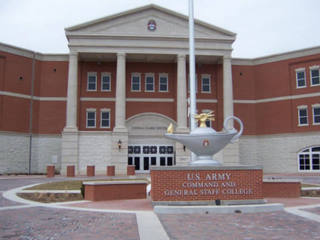
Interview with Dr James Sterrett, US Army Command and General Staff College
Dr Sterrett is the Deputy Director of the US Army Command and General Staff College’s Digital Leader Development Center’s Simulations & Exercises Division. Yes, that’s a loooooooong title. The short version is: he uses wargames for training, and gets paid for it. He’s also an avid hobby wargamer, and has spent about 7 years struggling to come to grips with the differences between “games” and “simulations” (pretty much since I introduced him to “Brant’s Theory of the Differences Between Games and Simulations”). In spite of this, he agreed to have a chat with us about his role at Ft Leavenworth.
Interview by Brant Guillory, 5 October 2013

Can you please give us an overview of the Digital Leader Development Center’s Simulations & Exercises Division, and what role they fill at the Command and General Staff College (CGSC)?
The Digital Leader Development Center (DLDC) supports CGSC’s exercises. DLDC has three major functions: providing and supporting Army and Joint mission command systems; providing and supporting simulations and exercise planning; and providing an exercise network for the simulations and the command systems.
Thus, Simulations & Exercises Division’s foremost job is exactly what it says on the label: put on the exercises the instructors want: selecting the best simulation for the job, ensuring it is ready to deploy into classrooms, preparing support materials, building scenarios, training student and faculty operators, and providing technical support. In addition, we teach the electives on training with simulations, exercise design, and exercise management; and we conduct R&D to find new simulations to meet the faculty’s needs. Sometimes we build them; we’ve got a very simple board game in testing at the moment, intended to help with classes in planning.
What sort of wargaming backgrounds do your team bring to the table, and how does that help them with their day-to-day jobs?
We’re all gamers. The Euler diagram of the overlap of our gaming hobby interests is pretty complex, and there are very few places where all of us overlap – but there are two keys ones. First, each of us brings some passion for the use of simulations in training and education. Second, all of us enjoy putting on games for other people: things such as building scenarios, designing and testing systems, or creating support materials – exactly the kinds of work we need done.
What’s a “week in the life” of preparing for a big wargaming event (say, a warfighter exercise) look like on the DLDC team? What about a “day in the life” of the actual exercise?
We don’t run anything as big as a warfighter; our biggest exercises are the division exercises. One of these is run for every section of 64 students, and they are run in two big batches: typically 5 or 6 in September, and 16-18 in February. The students use their own classrooms for the exercise. We teach 1 or 2 students from each section to be the technical lead for their section’s exercise. Those students then teach their fellow students how to operate the simulation – in this case, Decisive Action – and are the leads of the Tech Cell during the exercise, while we in Simulations are the on-call tech support.
One of the two Tech Cell students is usually an FA57 officer; Functional Area 57 is Simulation Operations, and one of their primary jobs in the Army is running exercises. Being the Tech Lead is a good experience for them and an opportunity to demonstrate to their peers what it is FA57s do. We usually call the non-FA57s “Temporary FA57s” for the exercise and thus refer to the whole group as FA57s, even though some of them are actually in other branches. Continue reading