02/23/14

First Impressions: Mark H. Walker’s Lock’n’Load Heroes of Stalingrad

The Grumpy Grog says “This is a new line of attack on an old campaigning favourite.”

Developed by Lock n Load Publishing and published by Matrix/Slitherine

First Impressions by Boggit, 23 February 2014

Click images to enlarge

I’ve never played any of the Lock’n’Load games before, so this is a truly fresh look at this game. I am looking at this game with the beta update v1.04. The game is tactical in scope, and each hex represents about fifty meters across, each turn represents 2-4 minutes, and each counter is a single vehicle, an individual, or a group of soldiers: for example, a half squad, or a weapons team.

Starting the game for the first time, the player is set up at the introductory level. This is a particularly forgiving mode that can be changed in the main menu. I immediately changed it to “hard”, which runs the game under unmodified rules. “Normal” gives a dice bonus. Rash perhaps, but you’ll see no signs of weakness from me!


HoS1
The options screen gives a good choice of items to customise your game.

The main menu gives the usual options. Essentially it is the place to start a new game, load an old one, create missions and scenarios with the editor, and to play multiplayer. In multiplayer, the user needs to set up a Matrix/Slitherine account and you’re then taken to the Multiplayer lobby. From there you can create a new game for someone to play with you, go onto the forum, and can check-in on your own games. I’d seen this before with Field of Glory, and it is a very user friendly multiplayer system. I’m glad they didn’t reinvent the wheel on this one, as it works, and works well. The only downside was a very empty multiplayer lobby, but to be fair, the game’s just come out, so that should change with time. Continue reading

09/25/13

Combat Mission Fortress Italy: Gustav Line – PC Game Review

Developed and Published by Battlefront Inc.

Author: Boggit

Last year I reviewed the core game and first instalment of CMFI . That review was positive in most respects, and particularly for the innovations to the CMx2 engine. I was however, mainly critical for the omission of any Commonwealth troops for a Sicilian campaign, and for the scarcity of “historical” scenarios with regard to the history of US forces in action. So what does Fortress Italy Gustav Line add to the core game?

Well the short answer is that Fortress Italy Gustav Line is a huge improvement to the core game. It adds a considerable amount of new nationalities, combat formations, equipment, campaigns, scenarios and quick battle maps. It also adds some new features previously unseen in the CMx2 engine.

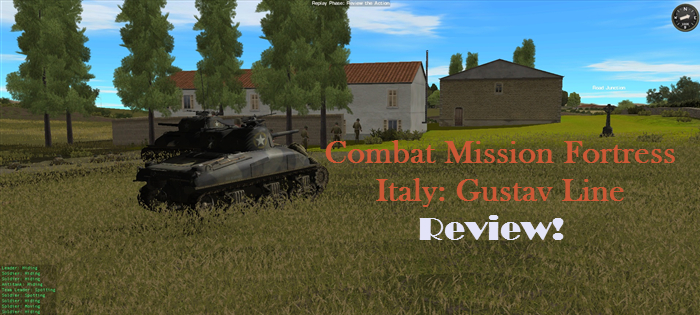
US Scouts under fire from Flakvierling
Take cover!! US Scouts come under fire from a Flak Vierling.

At last the Commonwealth forces make their entry, starting with Operation Husky in Sicily. Battlefront has added many new combat organisations, vehicles etc. to the existing mix giving much more variety. In addition to the US army the Allies now comprise the Poles, Canadians, British, and New Zealanders. For the Axis there we see the fearsome Fallschirmjägers, which now debut on the Plain of Catania in Sicily, and later can make their famous stand in the devastated town and abbey of Monte Cassino. Similar to the other Combat Mission games in the CMx2 series, combat formations are well researched to reflect the historical unit organisation in the Italian theatre of operations. A nice touch for picky Grogs like me! To put this all into perspective Fortress Italy Gustav Line specifically adds:

  • 7 new US formations including the Glider Infantry Battalion and the Cavalry Reconnaissance Squadron
  • 25 new German formations including the Luftwaffe’s Parachute Pioneer Battalion (which is great for assaulting built up areas), to the Heer’s Grenadier Battalion, which has three variations to itself- the 1942, the 43, and 44 type.
  • 18 Commonwealth formations (although the availability of particular Commonwealth Formation types vary by national army, as well as any organisational and equipment differences between the Commonwealth forces). These include formations like the Air Landing Battalion (Great for fighting the early days of Operation Husky around the city of Syracuse), and the Armoured Recce Regiment.

Continue reading

09/14/13

Victorian Admirals Anthology – PC Flash Review

Developer Totem Games

Publisher: Strategy First

Author: Boggit

I picked this quirky little naval gem on sale at Gamersgate. It’s quite fun, being focused on four small campaign scenarios set in the late Victorian period. Ships haven’t yet made the full transition to the warships we know from the First World War period onwards, so you’ll see ironclads with rigging, and many ships organised for broadside fire, although some get turrets.

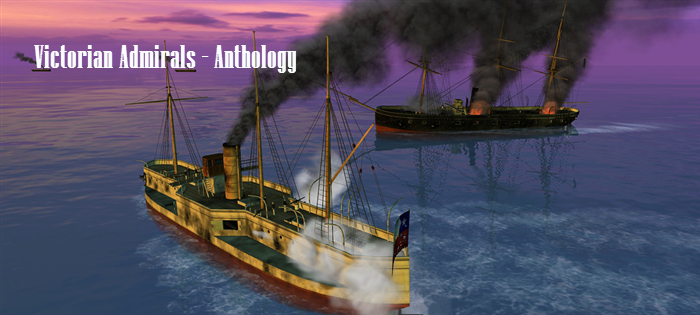
Boggitz-Victorian-Admirals-Sept-2013-VA2

The Spanish turret ship Puigcerda at bay. With her 8” guns and heavy armour, she played hell with my squadron .In the background one of my cruisers, the USS Boston, limps away heavily damaged.

I took my screen shots from the Marianas Incident 1887 mini campaign, where I played as a Yankee squadron commander. Whilst I won the game, all my cruisers, and my casemate ironclad had to withdraw due to critical damage, but I sank all the Spanish ships save one turret ship. I thought the AI put up a reasonable fight, although that could just be me overestimating my skills as a Commodore, or Admiral…

Continue reading

09/2/13

Sid Meier’s Ace Patrol

Developer: Firaxis

Publisher: 2K Games

Author: Boggit

click images to enlarge

Sid Meier’s Ace Patrol is a game about aerial combat on the Western Front during the First World War. As my prayers so far for a re-release of an updated, and revamped version of Achtung Spitfire, Over the Reich, and Flight Commander 2 have so far gone unanswered, I picked this one up as it seemed somewhat reminiscent of them.

acepatrol1

The Interface is intuitive and easy to learn. The game also features a “Baron-o-pedia” for extra information.

For a game about the First World War, it is a surprisingly very “PC” game for the PC. You can’t die, and you can’t kill your opponents. Following the suspension of historical accuracy is that half your pilots are women, you can play the US in 1916, and you don’t seem to have any limits on ammunition. Your opponent pilots seem to acquire combat victories at a surprising rate, even after you shoot them down several times, so that by the late war they often have more kills than your own aces – weird! That’s about the worst of it. It’s definitely NOT a “Grognard game”, but in my opinion it’s fun, and light relief – a good “Beer and Pretzels” game. As to gaming challenge, it offers five levels of difficulty from “Rookie” to “Legend”, which gives victory point multipliers for successful missions.

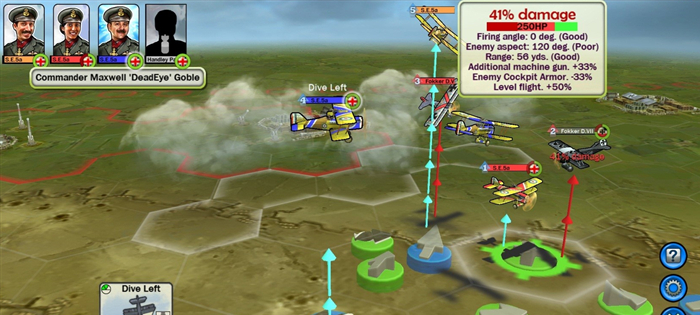
acepatrol2

The game map is clear and informative. Note the different manoeuvre options, cloud, and “Archie” cover (red hexsides). The front line is clearly evident, and can determine the fate of shot down aircrew.

Continue reading

07/27/13

Birth of Rome Review – Part 1

Developer: AGEOD

Publisher: Matrix Games/Slithereine Ltd.

Author: Boggit

Recently, AGEOD created the standalone ancients game Birth of Rome. For players new to the AGEOD ancients world, it is a standalone expansion of their earlier game– see here for my earlier review of the core game. For owners of Alea Jacta Est it is essentially a scenario pack of 6 new scenarios. Boggit takes the Grog’s view of whether it is a “Spoil of War” or just “a collection of broken swords.”


There has been some mixed debate in the Matrix forums regarding the game, with two issues being of greatest concern. Whilst some critics have been a little toxic as to the “value” of the game scenarios, there is reasonable constructive criticism regarding “drive bloat” for existing owners of Alea Jacta Est. The concern here is core game files being duplicated just to play the additional scenarios, so adding unnecessarily to drive space. This isn’t actually as bad as it sounds and a quick email to the developer provided a workable solution, provided here:

Essentially all you need to do is take all the content of the Scens folder of Alea Jacta Est and add it to Birth of Rome, and do the same for the Events folder, then this should be ok. Birth of Rome will then be Birth of Rome + Alea Jacta Est… And you can uninstall Alea Jacta Est afterward (after ensuring that the core Birth of Rome game works)…. Problem sorted!

As to the scenarios, there are six, namely:

  • 3rd Samnite War 298BC (104 turns)
  • Ager Gallicus 283BC (31 turns)
  • Pyrrhic Victories 283BC (70 turns)
  • First Punic War 264BC (284 turns)
  • First Punic War 256BC (183 turns) (Punic War Lite…? At 183 turns I’m ROFL!)
  • Mercenary War 241BC (48 turns)

It must be said that as a game, or scenario pack – depending on whether you are already an owner of the excellent Alea Jacta Est – this early Roman period is rarely seen as a wargame, making this a fresh experience for “Roman Period” gamers.

Unlike previous one off scenario reviews, I’m dealing with six scenarios. To keep this article manageable I’ll summarise each scenario with a bit of background history, a little AAR, together with gameplay observations and my assessment of how the scenario played out both in terms of historical accuracy and as entertainment. Hopefully, that will make the review an easy read, yet give you a fair idea as to what you’re getting for your money if you buy the game.

3rd  Samnite War (298-290BC)

The Samnites had fought several earlier wars with Rome for the supremacy of Central Italy. As part of this ongoing struggle the Samnites attempted to ally with the Lucanians. The Lucanians did not agree, so the Samnites attempted to compel them by force. The Lucanians turned to Rome, and drove out the Samnites. In response the Samnites forged more alliances with the Senones (a Gallic tribe), and the Etruscans.

The main Samnite army was commanded by Gellius Egnatius, and Rome’s under L. Scipio Barbatus. At the battle of Cemerinum in 295BC Scipio was defeated. Rome then raised its largest force to date and campaigned against the opposing Italian tribes and Senones in northern Umbria. Gallic forces caused significant Roman losses, but ultimately the Romans prevailed and destroyed the alliance. This resulted in Rome receiving the surrender of the Umbrian rebels, the occupation of the Senones’ territory, and peace with the Etruscans. Having disposed of the allied forces, subsequent campaigns were fought against the Samnites until they sued for peace in 290BC. Ironically for a defeated enemy of Rome the Samnites received citizenship without the vote. The later war against the Senones would not be so considerate… At the end of the Third Samnite War, Rome was pre-eminent in Central Italy and its territory now extended across the peninsula from the Tyrrhenian Sea to the Adriatic.
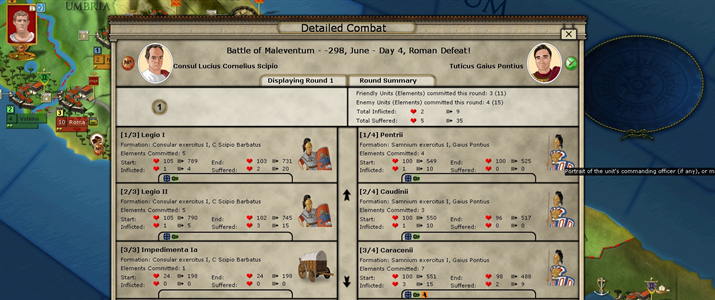
Boggitz-Birth-of-Rome-Review-Part1-BOR1

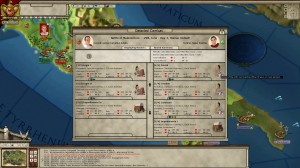
Roman progress is slowed in an early skirmish. Check out the unit artwork… nice. 

Continue reading