08/7/13

Go To Games: 7 Wonders

Brant Guillory, 7 August 2013

For a lot of people, their “go-to” game is the game they boot up on the computer when they have time to kill in the evenings, or over a weekend when they’ve got the game on TV and want to safely ignore commercials.  And while I have a few casual “go-to” games in the digital world, I would be remiss if I failed to extoll the virtues of my tabletop “go-to” game for multi-player gatherings: 7 Wonders.


For most wargamers, 7 Wonders barely registered on their radar.  A fast-playing European production, 7 Wonders has an abstract combat mechanic, and one that can be safely ignored and still result in a resounding victory.  With so little battlefield relevance, it’s not wonder that many grogs steered clear of 7 Wonders when it was released.  Their loss.  Seriously.

7WONDERS_3D

The core schtick of 7 Wonders is a play-a-card city-building mechanic where players use resources to build parts of their cities, including attempting to build one of the Wonders of the Ancient World.  The original game came with players’ boards for the widely-acknowledged 7 Wonders of the Ancient World, but subsequent expansions (including a brand-new pack of boards) give players almost 20 options around which to build their cities, including the Colosseum, The Great Wall, and Stonehenge.

Continue reading

07/27/13

Birth of Rome Review – Part 1

Developer: AGEOD

Publisher: Matrix Games/Slithereine Ltd.

Author: Boggit

Recently, AGEOD created the standalone ancients game Birth of Rome. For players new to the AGEOD ancients world, it is a standalone expansion of their earlier game– see here for my earlier review of the core game. For owners of Alea Jacta Est it is essentially a scenario pack of 6 new scenarios. Boggit takes the Grog’s view of whether it is a “Spoil of War” or just “a collection of broken swords.”


There has been some mixed debate in the Matrix forums regarding the game, with two issues being of greatest concern. Whilst some critics have been a little toxic as to the “value” of the game scenarios, there is reasonable constructive criticism regarding “drive bloat” for existing owners of Alea Jacta Est. The concern here is core game files being duplicated just to play the additional scenarios, so adding unnecessarily to drive space. This isn’t actually as bad as it sounds and a quick email to the developer provided a workable solution, provided here:

Essentially all you need to do is take all the content of the Scens folder of Alea Jacta Est and add it to Birth of Rome, and do the same for the Events folder, then this should be ok. Birth of Rome will then be Birth of Rome + Alea Jacta Est… And you can uninstall Alea Jacta Est afterward (after ensuring that the core Birth of Rome game works)…. Problem sorted!

As to the scenarios, there are six, namely:

  • 3rd Samnite War 298BC (104 turns)
  • Ager Gallicus 283BC (31 turns)
  • Pyrrhic Victories 283BC (70 turns)
  • First Punic War 264BC (284 turns)
  • First Punic War 256BC (183 turns) (Punic War Lite…? At 183 turns I’m ROFL!)
  • Mercenary War 241BC (48 turns)

It must be said that as a game, or scenario pack – depending on whether you are already an owner of the excellent Alea Jacta Est – this early Roman period is rarely seen as a wargame, making this a fresh experience for “Roman Period” gamers.

Unlike previous one off scenario reviews, I’m dealing with six scenarios. To keep this article manageable I’ll summarise each scenario with a bit of background history, a little AAR, together with gameplay observations and my assessment of how the scenario played out both in terms of historical accuracy and as entertainment. Hopefully, that will make the review an easy read, yet give you a fair idea as to what you’re getting for your money if you buy the game.

3rd  Samnite War (298-290BC)

The Samnites had fought several earlier wars with Rome for the supremacy of Central Italy. As part of this ongoing struggle the Samnites attempted to ally with the Lucanians. The Lucanians did not agree, so the Samnites attempted to compel them by force. The Lucanians turned to Rome, and drove out the Samnites. In response the Samnites forged more alliances with the Senones (a Gallic tribe), and the Etruscans.

The main Samnite army was commanded by Gellius Egnatius, and Rome’s under L. Scipio Barbatus. At the battle of Cemerinum in 295BC Scipio was defeated. Rome then raised its largest force to date and campaigned against the opposing Italian tribes and Senones in northern Umbria. Gallic forces caused significant Roman losses, but ultimately the Romans prevailed and destroyed the alliance. This resulted in Rome receiving the surrender of the Umbrian rebels, the occupation of the Senones’ territory, and peace with the Etruscans. Having disposed of the allied forces, subsequent campaigns were fought against the Samnites until they sued for peace in 290BC. Ironically for a defeated enemy of Rome the Samnites received citizenship without the vote. The later war against the Senones would not be so considerate… At the end of the Third Samnite War, Rome was pre-eminent in Central Italy and its territory now extended across the peninsula from the Tyrrhenian Sea to the Adriatic.
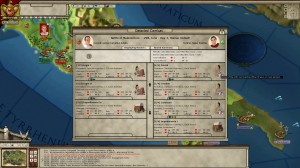
Boggitz-Birth-of-Rome-Review-Part1-BOR1

Roman progress is slowed in an early skirmish. Check out the unit artwork… nice. 

Continue reading

06/3/13

Alea Jacta Est – Spartacus Scenario DLC

Author: Boggit

Developer and Publisher:  AGEOD and Matrix Games

In December Boggit reviewed the core game Alea Jacta Est, which offers the same game mechanics as Birth of Rome – you can see that original review here https://grogheads.com/rev-aje.html. AGEOD/Matrix has complemented this outstanding game with the Spartacus scenario, so Boggit takes the Grog’s view of whether it should “be crucified” or “granted a Rudis.”

For those gamers with Alea Jacta Est it is recommended to upgrade to the v1.02 patch. This is not necessary for those players using Birth of Rome only since V1.02 is the standard version shipped. V1.02 adds a number of nice features including tabs for city and fort size, enabling these important values to be spotted at a glance, but most importantly if you want to be able to play Spartacus you do need to patch to v1.02 from vanilla or from v1.01.
Continue reading

02/22/13

Alea Jacta Est – Cantabrian Wars Scenario DLC


Reviewed by Boggit, 22 February 2013

Developer and Publisher: AGEOD and Matrix Games

Back in December Boggit reviewed the well-received core Alea Jacta Est game – see here for the original review. Recently, AGEOD have added to this excellent game with the Cantabrian Wars scenario. Boggit takes the Grog’s view of whether it is a “Fiery War” or should “Just burn”.

For those gamers with Alea Jacta Est, it is recommended to upgrade to the v1.02 patch. V1.02 adds a number of nice features including tabs for city and fort size, enabling these important values to be spotted at a glance, but most importantly if you want to be able to play Cantabrian Wars you do need to patch to v1.02 from vanilla or from v1.01.

Continue reading

12/2/12

Review of Alea Jacta Est

Published and Developed by AGEOD

Reviewed by Boggit, 2 December 2012

Boggit returns to the “old days” when Rome ruled the world, and argued over it incessantly.

Click images to enlarge

Alea Jacta Est is the latest addition to the well regarded series of strategic/operational wargames produced by the Indie developer AGEOD. Alea Jacta Est is concerned with the wars of Ancient Rome with a particular focus on Roman Civil Wars, although it is possible to assume a non-Roman role in some of the scenarios.

For those who have played previous AGEOD releases, like Wars in America, Rise of Prussia, or Revolution Under Siege Alea Jacta Est will seem quite familiar at first sight. To some extent this is a superficial familiarity since the game engine has been tweaked for Ancient warfare rather than one where firepower is a critical factor, resulting in subtly different gameplay. For example, cavalry charges take on a new importance and are potentially deadly, depending on the terrain being fought over. There are also new siege rules reflecting the realities of Roman Legionary siege techniques and so on.

If you are new to AGEOD’s wargame titles the gameplay is quite unlike many wargaming titles where players tend to have considerable control over their pixel armies. Here you are in the world of the Commander in Chief – you can give your armies rules of engagement, set their aggression level (or combat stance) and order them to a location. There to do battle – or not! Commanders do not always follow orders to the letter, but can place their own interpretation on them based on their characteristics. This can result, for example, in a defensive or passive posture when you’ve instructed an aggressive stance. It can also result in generals delaying in implementing their orders. The classic example is Napoleon’s general Grouchy failing to pursue Bluecher – the aggressive/assault posture being modified to defend! It is a beautiful feature for a game at this level and particularly reflects the command and control difficulties of the pre-radio age.

Commanders can have a wide variety of traits, each of which can influence either their direct behaviour or the way they affect the political situation, for example Julius Caesar has as one of his traits “Fast mover” which gives a 15% stack move bonus, another trait is “Propagandist”, which gives a boost to loyalty in a region where he is present.


aje

Oh, happy day! Well not for the Senate anyway! Alea Jacta Est features lots of ancient “events”.

  Continue reading