09/30/13

Battle Academy – Operation Sealion Expansion PC Game Review

Developer: Matrix/Slitherine
Author: Boggit

click images to enlarge

In September 1940, the UK was bracing itself against the prospect of invasion from Nazi Germany. Fortunately, it was called off, largely due to the failure of the Luftwaffe to achieve its goal of air superiority during the Battle of Britain. Battle Academy – Operation Sealion gives us Matrix/Slitherine’s take on what sort of actions might have been fought had Operation Sealion been given the go ahead.

Battle-Academy-Operation-Sealine-Review-Sept-2013-OS1
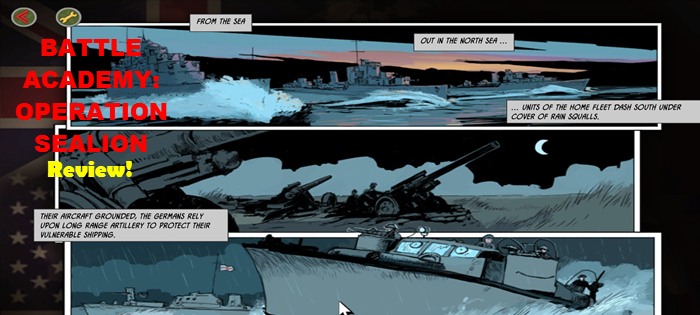
Sitrep, Sir! Jerry’s got the airfield, and we’ve got to get it back. You have regulars, and “Dad’s Army”. Easy, eh?

Battle Academy is a tactical level, turn-based, fast play type wargame. The map is a grid of squares, with each square – if unit ranges are anything to go by – representing some 100 metres across. That at least is what I concluded, as it seemed obvious. I’ve since learned from Jim Zabek that when he wrote the core game review for the Wargamer, Slitherine told him that in fact the ranges were not linear. For some curious design reason each square has a logarithmic variation… Sealion is an expansion to the core game, so this logic likely applies here too. Units are portrayed as single vehicles, guns, with infantry in units of five men, and support weapons like LMG’s and mortars, typically two. There are no specific unit organisations, but in terms of the game scale, I found it easy to rationalise each unit as a representative infantry platoon, or support/tank section.

Gameplay is flexible, with units able to move and fire, in whatever order the player likes. A player can tweak their starting force by spending a limited supply of “force requisition points”, which has the effect of adding variation to the stock scenarios. The rules are simple, yet effective, providing a fun game with a modicum of realism. Off map assets, from artillery to airstrikes are represented, as is unit training, replacements, fresh supplies etc. Vital to game play are the spotting rules, and ambushes from cover represent a real threat. Most of the challenge of the game is in the scenario design rather than the AI. Whilst the AI is not overly challenging – even on the hardest level – the majority of scenarios in Battle Academy – as well as many user made ones – have nasty surprises to trap the unwary, often making good use of the spotting rules. Continue reading →
09/25/13

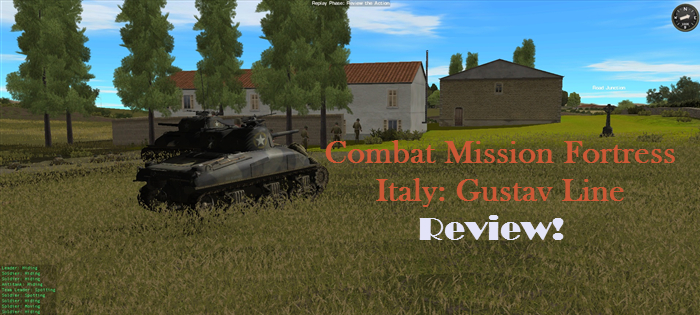
Combat Mission Fortress Italy: Gustav Line – PC Game Review

Developed and Published by Battlefront Inc.

Author: Boggit

Last year I reviewed the core game and first instalment of CMFI . That review was positive in most respects, and particularly for the innovations to the CMx2 engine. I was however, mainly critical for the omission of any Commonwealth troops for a Sicilian campaign, and for the scarcity of “historical” scenarios with regard to the history of US forces in action. So what does Fortress Italy Gustav Line add to the core game?

Well the short answer is that Fortress Italy Gustav Line is a huge improvement to the core game. It adds a considerable amount of new nationalities, combat formations, equipment, campaigns, scenarios and quick battle maps. It also adds some new features previously unseen in the CMx2 engine.

US Scouts under fire from Flakvierling
Take cover!! US Scouts come under fire from a Flak Vierling.

At last the Commonwealth forces make their entry, starting with Operation Husky in Sicily. Battlefront has added many new combat organisations, vehicles etc. to the existing mix giving much more variety. In addition to the US army the Allies now comprise the Poles, Canadians, British, and New Zealanders. For the Axis there we see the fearsome Fallschirmjägers, which now debut on the Plain of Catania in Sicily, and later can make their famous stand in the devastated town and abbey of Monte Cassino. Similar to the other Combat Mission games in the CMx2 series, combat formations are well researched to reflect the historical unit organisation in the Italian theatre of operations. A nice touch for picky Grogs like me! To put this all into perspective Fortress Italy Gustav Line specifically adds:

  • 7 new US formations including the Glider Infantry Battalion and the Cavalry Reconnaissance Squadron
  • 25 new German formations including the Luftwaffe’s Parachute Pioneer Battalion (which is great for assaulting built up areas), to the Heer’s Grenadier Battalion, which has three variations to itself- the 1942, the 43, and 44 type.
  • 18 Commonwealth formations (although the availability of particular Commonwealth Formation types vary by national army, as well as any organisational and equipment differences between the Commonwealth forces). These include formations like the Air Landing Battalion (Great for fighting the early days of Operation Husky around the city of Syracuse), and the Armoured Recce Regiment.

Continue reading →

09/14/13

Victorian Admirals Anthology – PC Flash Review

Developer Totem Games

Publisher: Strategy First

Author: Boggit

I picked this quirky little naval gem on sale at Gamersgate. It’s quite fun, being focused on four small campaign scenarios set in the late Victorian period. Ships haven’t yet made the full transition to the warships we know from the First World War period onwards, so you’ll see ironclads with rigging, and many ships organised for broadside fire, although some get turrets.

Boggitz-Victorian-Admirals-Sept-2013-VA2

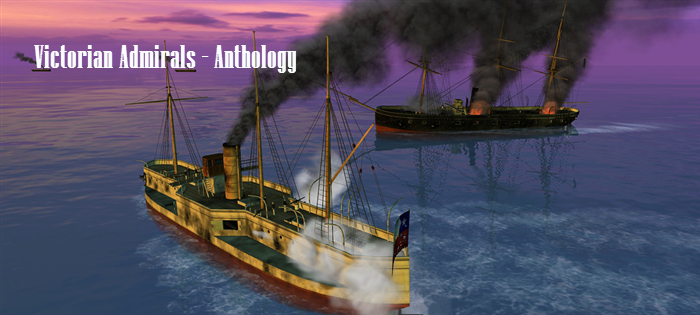
The Spanish turret ship Puigcerda at bay. With her 8” guns and heavy armour, she played hell with my squadron .In the background one of my cruisers, the USS Boston, limps away heavily damaged.

I took my screen shots from the Marianas Incident 1887 mini campaign, where I played as a Yankee squadron commander. Whilst I won the game, all my cruisers, and my casemate ironclad had to withdraw due to critical damage, but I sank all the Spanish ships save one turret ship. I thought the AI put up a reasonable fight, although that could just be me overestimating my skills as a Commodore, or Admiral…

Continue reading →

09/7/13

Total War: Rome II – First Impressions

Developer: Creative Assembly

Publisher: Sega

Author: Lloyd Sabin

This Is How We Do It

Here at Grogheads we do things a bit differently. We don’t race to get the latest review of the hottest game up before release day. We have never felt that was the correct way to go about it. So our “First Impressions” piece hasn’t been released in the first 24 hours. It has taken us a few days to reconnoiter the game. Four days of gameplay doesn’t make a review, but it has given us something worth reporting.

We slowly wade into games most of the time, patiently observing, trying out features, taking notes and then ranting and raving like drugged cave men if something is wrong. Which brings me to my first point.

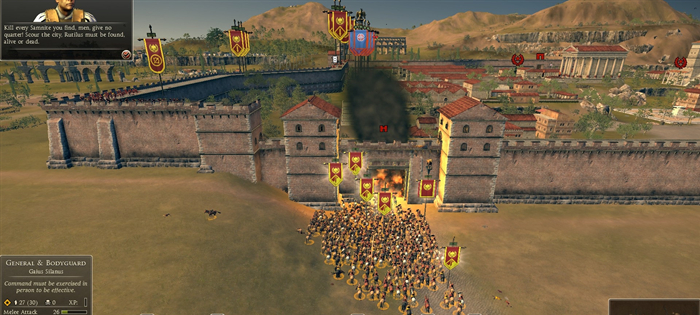
Total War Rome II Impressions Rome 5

Rome II is here, and there are many people with things to say about it as usual. Below are some of my notes on my first few hours with Creative Assembly’s latest.

Total War, Total Chaos

Once the dust has settled on the release of Total War: Rome II – More Gooder, The Sundering of Wallets, or just Total War: Rome II, for short, the next title should absolutely be Total War: Release Day Antics. I have been playing computer games for 25+ years and have been writing about them for 10+ years, and I have never seen such chaotic division, screaming, ranting, and virtual insanity as I have upon a Total War release – before the game was released. Continue reading →

09/6/13

Germany at War: Barbarossa 1941 – PC Game Review

Developer: Phobetor

Publisher: Slitherine/Matrix

Author: Jim Cobb

Panzer General has engendered many sequels, add-ons and clones over the last twenty years. All have kept the original interface’s feel and most have been interesting. Yet, historical accuracy has taken second place to ease of play and fun. With Germany at War – Barbarossa 1941, Slitherine/Matrix and developer Phobetor have refurbished their earlier Operation Barbarossa – The Struggle for Russia and have brought the genre to a higher level.

Dusty Steppes

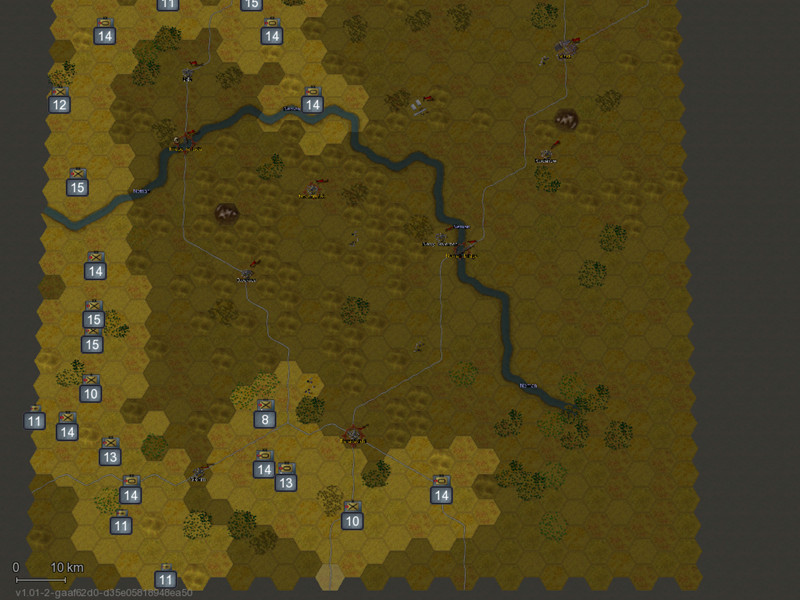
Players used to the somewhat verdant fields of Panzer Corps may find the summer and fall terrain of the game a bit plain. Brown and tan are the dominant colors but nobody said Russia was Eden. Winter scenarios have the usual white landscape. Any aesthetic loss is made up for in clarity. Village and city names are printed on the map and terrain features including pillboxes are easily identifiable. Objectives are encircled by a gear-like symbol. Vehicle icons are slightly murky even when zoomed in but can be seen as their types. Action points determine the amount of activity possible in a turn but are distinctive enough. Infantry and artillery are portrayed well. Aircraft look fine except spinning props like a CD stuck on the plane’s nose. The strength of each unit is clearly indicated on the icon and the selected unit’s screen yields more details via tool tips. Players turned off by the icons can opt to use NATO symbols. Weather is displayed very well with sheets of rain and snow while heavy clouds swirl in the air. Animation is adequate with tanks and half-tracks moving smartly, infantry turning to meet challenges, and horses galloping.

gawbsumm

The monotony of the steppes can cause agoraphobia.

gawbwin

Typical winter near Moscow.

gawbunit

Panzers ready to roll! Continue reading →