Review by Jim Zabek, 16 January 2013
from Sony Pictures/Columbia Pictures, directed by Kathryn Bigelow
It won a Golden Globe for Best Picture, but is it a story Grogs will enjoy? Or sit around poking holes in? Jim Z investigates.
Zero Dark Thirty is the story of how the United States tracked down and killed Usama Bin Laden. At one point the movie highlights a comment made by then CIA Director Panetta that, “Everyone here (at the CIA) is smart.” That they were, but it took more than brains to succeed, and Zero Dark Thirty successfully manages to compress a highly complicated, decade-long manhunt into two hours and thirty-seven minutes. At its heart it tells the story of a single CIA agent who managed to see what others could not – that a single courier was being protected by every terrorist detainee who knew him, and he was the key to finding Bin Laden. Excellent instinct, and an almost superhuman tenacity of swimming upstream against a skeptical bureaucracy – these are the traits which ultimately delivered success.
 Opening with a powerful scene of an interrogation of an Al Qaeda operative the audience is confronted with the brutal but ultimately effective tactics used to break down the terrorists involved in the 9/11 attacks. It is an ugly scene but manages to convey the complicated message that the US was prepared to go to great lengths to prevent another attack and that the “enhanced interrogation” techniques used, while brutal, were effective. Some critics have suggested that the scene “glorifies” the enhanced interrogation methods used. In my view there is nothing glorious about the scenes. They are harsh, and reflect brutal measures conducted on brutal, tough people. These scenes can be disturbing, and some audience members may not be able to directly look at these scenes. They are by far the most graphic of the movie.
The story closely follows the history over the last decade, and while there may be some minor deviations from the public record – either for dramatic effect, obscuring the facts to protect the good guys, or to set the record straight (we’ll probably never know for sure) – the movie tells a complicated tale in an intelligible manner. I went to see the movie with my wife, who has not followed the news closely, so I had a solid basis with which to compare notes. Even significant news events, such as the helicopter crash during the raid were unknown or forgotten to her. There were probably half a dozen times where I either whispered some kind of clarification to her or she asked a question of me. While she was able to follow the movie and understand most of it without pointers, the average person off the street may find a few items confusing or unclear, a few examples of which follow.
Well-known problems, such as Pakistan’s equivalent to the CIA, the ISI, being riddled with Al Qaeda supporters, were never made clear during the movie. Real world people depicted in the movie were not explained, and while the overall arc of the story was relatively easy to follow, there were clearly a number of moments where context and insight would have been valuable. Even people who follow the news closely – like me – may have difficulty recognizing events or people of significance. Subtitles introducing the players could have helped. These kinds of details, while lengthening an already long movie, could have transformed Zero Dark Thirty from an already great movie, into an even greater one.
The lack of context and detail, however, did not have a significant impact on appreciating the overall story, but bringing some of the above examples into greater focus could have helped further educate an audience that otherwise might not be up to speed on events over there. The movie on the whole, delivers and can and should be seen whether you’ve followed the news or not, though it may be helpful to bring a friend to add context at certain times. That said, Zero Dark Thirty begs for a Director’s Cut when it is released on DVD/Blu-Ray. There is so much more that the average American should know about events overseas and Zero Dark Thirty is a perfect instrument to help the public understand a messy, complicated, and deadly adversaries as well as the tools used to track down and kill them.
Being able to tell a complicated story in an understandable and entertaining manner is a rare feat and takes top-shelf talent. Zero Dark Thirty succeeds and does so impressively. Perhaps what is most striking to me was how artfully the movie was constructed. The climax of the movie – the raid on UBL’s compound – while dramatic, was also almost – almost – a letdown. There was a great deal of drama during the raid, yet its depiction on the screen was closer to clinical than a blaze of glory. In that respect the movie as a whole takes on something of a documentary style, yet still remains dramatic and, as best I can tell, historically accurate.
Perhaps the highest compliment I can pay Zero Dark Thirty is to compare it to the classic Tora! Tora! Tora!. 9/11 has often been compared with the attack on Pearl Harbor, and like Pearl Harbor’s dramatized documentary Tora! Tora! Tora!, Zero Dark Thirty is an instant classic about a world-altering event. Tora! Tora! Tora! is a different movie about a different generation.. One striking difference is that Tora! Tora! Tora! was G-rated, while Zero Dark Thirty carries an R rating. Though similar in length, Zero Dark Thirty presents a history that is not well known, whereas with Tora! Tora! Tora! a great deal of the historical context and events were well understood by contemporary moviegoers. I have found the need to explain more about Tora! Tora! Tora! to those unfamiliar with the history of the period – far more than was required in Zero Dark Thirty. Regardless of the similarities and differences, I predict Zero Dark Thirty will be an equally significant film as Tora! Tora! Tora!, and one that my children are likely to turn to when they wish to educate their children on the topic.
Zero Dark Thirty succeeds in educating its audience while remaining explosively entertaining. It manages to educate its audience on a topic that has mostly taken place in a scope that was deliberately out of their knowledge – a secret and classified world. Zero Dark Thirty manages to introduce the public to that world, explain it, and entertain in a timeframe that is daunting. I applaud them on their success. I hope that when the DVD/Blu-Ray release arrives the director sees fit to take advantage of the opportunity to make an already highly entertaining and informative movie into one that fills in the few gaps and makes it complete.
Regardless of the minor shortcomings in information, there is no excuse not to see Zero Dark Thirty. The few things missing from the narrative won’t detract from the drama. Zero Dark Thirty is a must-see. Watch it, learn from it, enjoy it.
Discuss this review in our forums >>

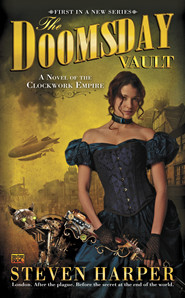 “Steampunk” is one of those literary terms that’s being thrown out all over the alternative fiction world – hard to call it just ‘sci-fi’ when there are hefty fantasy and historical elements to it – and is rapidly becoming a widely-recognizable genre that’s crossing RPG, boardgaming, videogaming, comics, and long-form fiction lines. Updating the worlds imagined by Verne and Wells, among others, Steampunk narratives have transcended RPGs like Space:1889 and Castle Falkenstein to bubble up into best-selling books, and TV shows like Warehouse 13.