Just one question: Why doesn’t a computer game have the invention of computer games as a technological advance to research?
Click images to enlarge
Persians! Why did it have to be Persians!
Now that I’ve started to run into other civs, I can’t stop running into them.
Scouts on the Run!
My scouts on autopilot just seem to be danger magnets. First they were idiots. Then they were directionally-challenged. Now they’re daredevils.
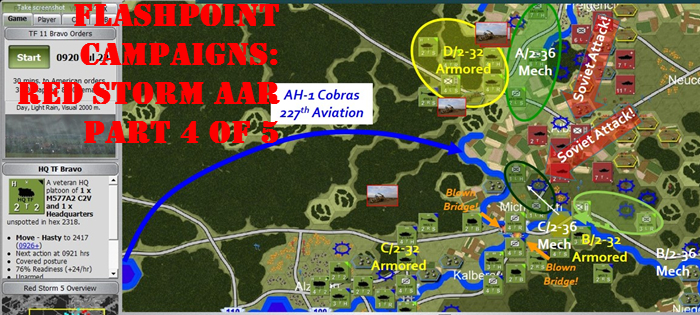
During Part 4 the battle for Michelbach turned into a raging fight. Some badly needed reinforcements arrived in the form of Cobra attack helicopters. Meanwhile my American forces blasted the Soviet attack from three sides. Just as I had identified the position of the Soviet HQ and started to bombard it with artillery the Soviets began to withdraw and the game’s rules kicked in ending the scenario despite the fact that there were still eight hours on the clock.
Turn 8, 09:50-Conclusion: Well my instincts with respect to the Soviet position were good and after a few more rounds flew the Soviet point units began pulling back and the following message was received in Comms (figure 25).
Figure 25
So now that the battle is over how did I do? A review of the Tactical Operations Center (TOC, Figure 26) indicates my defense achieved a 73 percent rating for a “Decisive Success.”
Figure 26
As you could expect the Soviet TOC results (Figure 27) were as lopsided as the American’s with the Soviets suffering a Decisive Loss and loosing 5 Recce, 18 Helo, 78 Tank, 98 APC, 65 Inf, 5 SP AT, 24 HQ, 12 AD and 11 SP Arty enemy subunits.
Figure 27
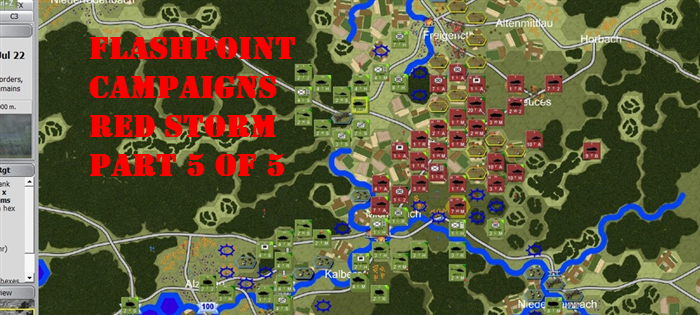
A finial look at the battlefield before the Soviet began to pull back to more defensive positions (Figure 28)
Figure 28
Conclusions: It is my hope that I was able to both illustrateboth the rich detail in the game and the amount of planning that one can (should) conduct to (successfully) play the game. Like I said, FPC:RS is an easy game to get into but there is a wealth of detail to master. I have found the more thoroughly I plan and analyze the battlefield situation, just as my real world counterparts must, the greater my chances of victory (whether I play as NATO or the Soviets). I would say I personally spend anywhere between one half hour to an hour analyzing the tactical situation and OB/OOB before I even begin to deploy my units. Personally, I enjoy that type of analysis and I hope you enjoy playing FPC:RS as much as I have enjoyed play testing it!
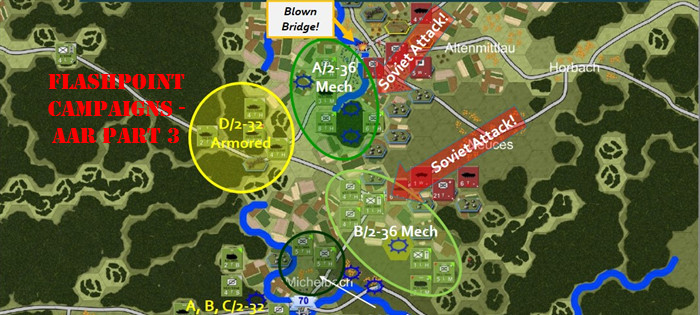
During Part 3 bad weather continued to hamper my plans. Limited visibility meant that the Soviets could get up close and personal before I could engage them. Reinforcements arrived to help out, but a wing of Soviet Hinds was battering one of my Abrams tank companies. Would the Cobra’s arrival come in time to tip the scales in my favor?
Turn 6, 08:50-09:20: The Soviet Hinds circling northeast of Delta/2-32 Armored didn’t disappoint and hit their position about 08:55. As the unit was prepared three (3) Hinds went down within five (5) minutes with the remaining Hind observed headed southwest. Radio warnings were relayed to Bravo and Charlie Companies and within minutes that Hind indeed attacked Charlie Company, majorly pressing its attack. For at least fifteen (15) minutes that lone Hind engaged an Abrams Company before it to exploded into a ball of flames. 2-32Armored’s S-2/Battlefield Information Coordination Center (BICC) has analyzed the likelihood of continued Soviet attack helicopter activity to be low and accessed the Soviet battalion to be rendered combat inoperative due to losses and damage.
Elsewhere the Soviet assault continues to attempt to overrun Charlie/2-36 positions in Michelbach and while they are close to breaking Charlie Co had driven back every assault so far. Plan on them being eliminated within the hour, but they have bought time for Bravo/2-32 Armored to enfilade the Soviet assault’s southern flank (Figure 23).
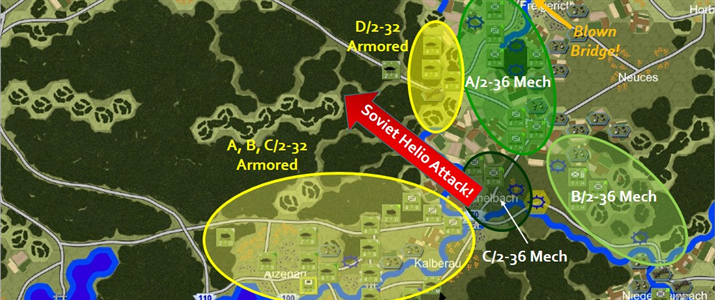
During Part 2, the first turn kicked off with several surprises. A Soviet helo attack inflicted serious damage on Bravo and Charlie companies of 2-36. However, Alpha company managed to set the charges to blow a critical bridge to impede the Soviet advance. The 2-32 armored battalion moved into position in good order. During the second turn Alpha company took heavy fire from the Soviets as they now attempted to blow the bridge, but the arrival of Delta company brought some armor into the fight which quickly dispersed the Soviet mechanized company giving Alpha so much trouble. Let’s see how Turn 3 unfolds.
Turn 3, 07:07-07:45: Things continue to go well with the general defensive plan this past 30-45 minutes. The northern Soviet thrust finally cleared two of the obstacle hexes but not before bombardment from friendly SPA M106 mortars and an F-16 airstrike called in by the FAC caused significant enemy casualties. Rather than trying to bridge the blown span their mechanized units turned southwest along the river running right up against one of Alpha Company’s mechanized platoons. With the American mechanized platoon now blocking the route southwestward the over watching Abrams of Delta 2-32 were able to savage the Soviets. Bolstering the defense were several batteries of the 94th Field Artillery (FA) Battalion arrived on the battlefield and hit the thrust with harassing fire. By 07:40 the Soviet lead units were pulling back (Figure 20).
Figure 20.
Around 07:15 a second Soviet mechanized thrust hit the line of resistance just east of Albstadt. As Bravo Company had been heavily attrited by the earlier helicopter attack this assault was a bit more successful, however one of Bravo Company’s platoons fought a stand up engagement with lead recon and armored elements. As I expected Bravo to be hit hard and planned for them to fall back, I’m not totally surprised but it looks like they will have to fall back to Michelbach earlier than I had planned.
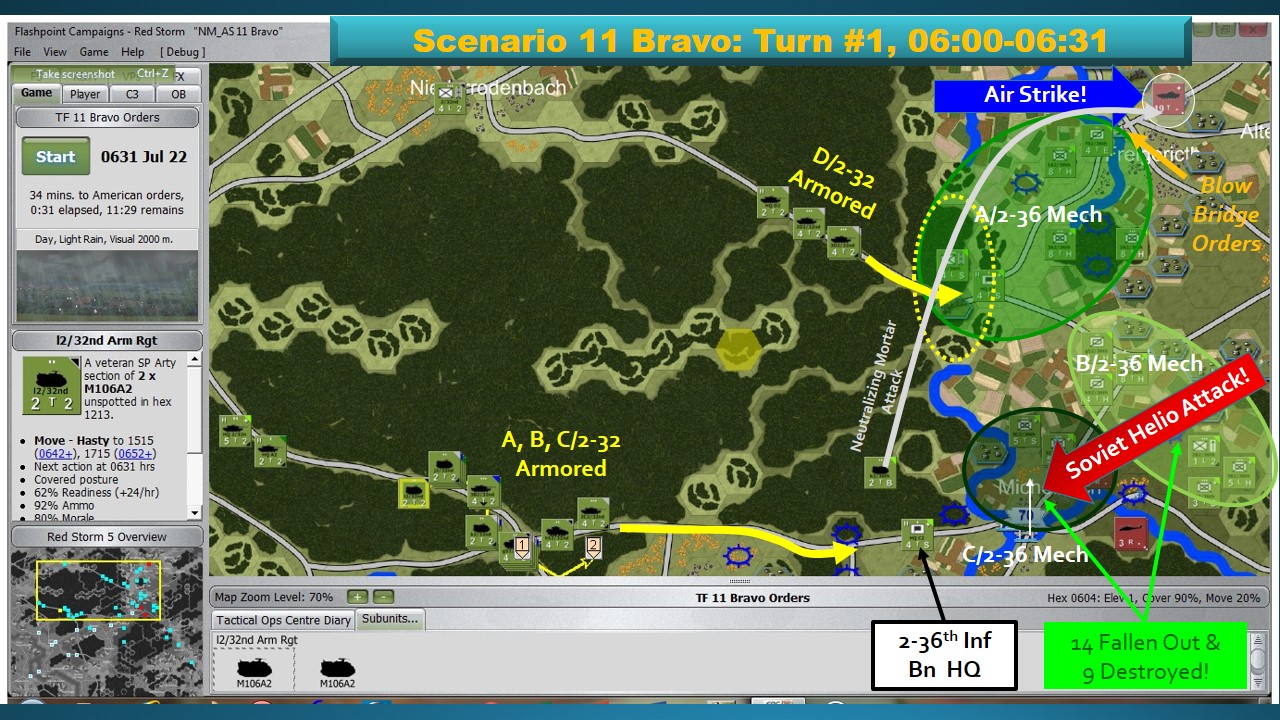
Turn 1 06:00-0631: Turn 1 started with a few quick surprises! The first was a Soviet attack helicopter assault that savaged Bravo and Charlie Companies of 2-36! For about 25 minutes they hit both companies knocking out 23 vehicles/units with 9 destroyed and 14 reported as falling out. It wasn’t totally lopsided exchange as two Mi-24 Hinds were brought down but still very damaging to my position! Probably the main thing that saved me was heavy rainfall moved in reducing visibility to 500 meters at the height of the fray. That actually was my second surprise of the turn, if we had maintained 1,500 meter visibility my Forward Air Controllers (FAC) would have been able to call in some F-16s to strike the Soviet units attempting to breach the obstacle belt (figure 18). Another thing that went wrong was my M106 mortar unit didn’t drop smoke as ordered leaving the Scout unit assigned to blow the bridge exposed. There appeared to be some kind of mix up with the fire orders.
All of that said some good things happened for me this turn as well. The previously mentioned scout unit attached to Alpha/2-36 did move up to the bridge and began to wire the preset charges. The OPs safely returned to my lines, and an exchange of fire between 1st Platoon/Alpha Company and the Soviet mechanized unit attempting the breach the obstacles resulted in some Soviet losses.
Elsewhere units from 2-32 Armored Battalion were advancing in good order and were close to assuming their defensive positions. Overall, concern about the Soviet helicopter battalion continuing to assault my mechanized infantry, and the variable weather/visibilities aren’t helping my cause right now either. Current visibility is 2,000 meters (about 1.25 miles) and if that holds I might try to call in more airstrikes toward 07:00-07:30.