09/9/12

PC Game Review of Panzer Corps AfrikaKorps

Review by Avery Abernethy, 9 September, 2012

Developed by Lordz Game Studio and Published by Slitherine

The Battle for North Africa was characterized by dramatic swings of fortune. GrogHead’s Avery Abernethy examines how the spiritual successor to the great Panzer General games takes on the subject.

The North African campaign in World War 2 represents one of the great “what if” moments of the war. Italy attempted a quick assault into Egypt from their territory in Libya in and were repulsed. The British seemed poised to conquer all of Italy’s African territories in early 1941 when Hitler sent Rommel and a small force of armor, infantry and air units ordering a holding action with very limited offensive actions. What followed was several years of see-saw warfare with large swings in momentum. Rommel’s Afrika Corps generally suffered from very poor logistics, was usually heavily outnumbered, and had little in the way of air support. Yet Rommel almost managed to cut the British supply lines by capturing the Suez Canal.

Continue reading

09/6/12

PC Game Review of Decisive Campaigns Case Blue

Review by Jim Cobb

Publisher: Matrix/Slitherine; Developer: Victor Reijkersz Games

Most wargames set on the Eastern Front have either too much abstraction or too much detail. Can Case Blue find a sweet spot in the middle?

aa

GrogHeads is pleased to induct Decisive Campaigns Case Blue into the Order of the Hex, for Accessible Accuracy. Case Blue’s East Front detail doesn’t short grogs seeking accuracy, but packages its gameplay in a sleek and solid interface.


Decisive Campaigns From Warsaw to Paris, Victor Reijkersz ’ first foray into historical operational games continues to be very popular. However, moving from the confines of Western Europe in 1939-1940 to the East Front in 1942 is like switching from the shallow end of the pool to the highest diving board at the deep end. Can Decisive Campaigns Case Blue make the transition?

Informative Eye-Candy

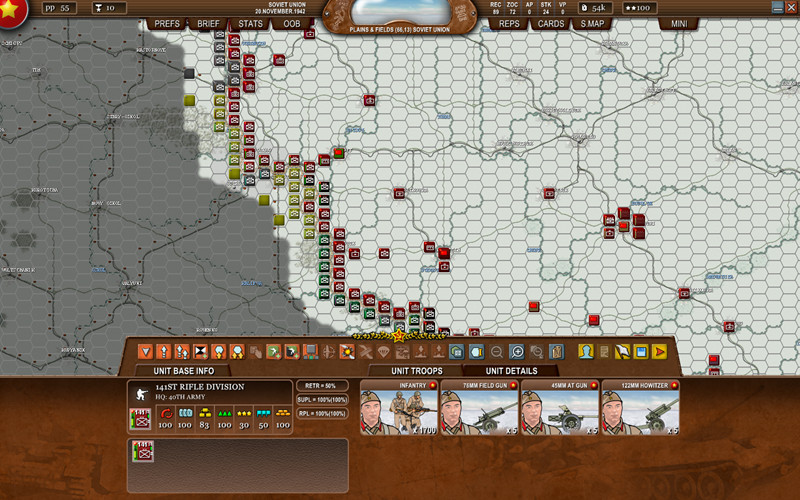
Although Case Blue may visually resemble From Warsaw to Paris, many changes to all aspects of play are evident. The zoomable map is a typical board-game type map with forty-km hexes and weekly turns. Each hex has a stacking limit over which units lose combat efficacy. Units are regiments, headquarters, and air groups. Smaller specialized units are also available. Combat units on the map have NATO symbols along with indicators for seven values such as readiness, and supply. Headquarters are marked with national flags, supply status and the all-important command points.


dccb

Continue reading

07/16/12

Book Review(s): A Tale of Two Snipers


Comrade Zabek and Oberhauptsturmfeldwebel Zabek face off over dueling accounts of sniper action on the Eastern Front of WWII.

Double Book Review of Red Sniper on the Eastern Front by Joseph Pilyushin and Sniper on the Eastern Front by Sepp Allerberger

This summer my reading list seems to have drifted to first-hand accounts of memoirs from the Second World War. Amazon, ever helpful in suggesting all kinds of temptations, served up two gems, both accounts written by men who were snipers on the Eastern Front, one Soviet, one Austrian. Both accounts are compelling for several reasons.

Perhaps most notably, both snipers served for years on the Eastern Front and returned home alive to share their experience (Allerberger began in 1943, Pilyushin in 1941). Also interesting is their experience on opposite sides of the war. Additionally their personal accounts are a study in contrast, with Allerberger’s discussing many details and techniques that helped him survive and even thrive, while Pilyushin’s account is written from a perspective that concentrates on the people he served with, almost completely devoid of a discussion of techniques and methods used in his craft.

Of the two books, Allerberger’s is the easier to follow. His narrative is clear in describing places, terrain,and other events. It comes across as a much more authentic memoir because of all these details. Caution should be exercised in reading – the account is at times disturbingly graphic in its discussion of war crimes witnessed by Allerberger.

These accounts remind the reader that the fighting on the Eastern Front was a savage as any war might possibly be. Allerberger, having fought for the Axis, naturally views these accounts as those perpetrated by the Soviets on the Axis. On one account Allerberger is particularly clear – the use of exploding bullets by snipers. He freely admits to using them, but his use of them is permitted because of a captured Soviet sniper rifle and ammo stock, not because he had been provided exploding bullets by Axis quartermasters.

Pilyushin’s account is a contrast to Allerberger’s, and reads less factually and more like a tragic play. The translator’s introduction explains that the account is devoid of most of the Soviet Communist propaganda that usually accompanies similar memoirs. He goes on to explain how popular the book was in the Soviet Union with readers.

Most of the book centers on Pilyushin’s time spent in and around Leningrad, and perhaps it is because the siege of Leningrad was assumed to be well understood by the reader that we read so little of the technical details of being a sniper. Much more prevalent is the discussion of Pilyushin’s friends and family, and there are hints of a romance with another (female) sniper. Pilyushin’s account is ultimately tragic; his family dies during the siege of Leningrad and his subsequent relationship with a fellow sniper ends tragically. The translator also shares insight that ultimately Pilyushin’s head wounds cost him his eyesight.

Both books are recommended for readers seeking insight on a personal level to the Second World War. Of the two, Allerberger’s is more technical, while Pilyushin’s is quite personal. Together the reader will gain perspective of the war from two sides, with completely different approaches and perspectives from people who performed nearly identical roles. Both belong in the collection of military history buffs and they are highly recommended.

Editors note: Both books were read on a Kindle Fire, so both are available as e-books for readers who want them in a digital format.

Discuss this in our forums!


05/23/12

Wargaming On The Go! – Small General

Brant Guillory, 23 May 2012

Developed by VR Designs

click images to enlarge

Looking for a grognard-quality game in a light, on-the-go package? Walk, don’t run, to your Android phone and grab this little gem.

Is That A Battle In Your Pocket…?

sg

Small General is a light wargame for the Android OS that has a generic-but-roughly-WWII-era theme that offers some interesting tactical challenges in a package that plays quickly, but still offers a robust grog-friendly experience. The “beta” is available as a free download, and includes about 5 scenarios of varying size/challenge. The paid version unlocks significantly more content. Moreover, the AI in the paid version seems to cheat less, but maybe it’s just me!

Small General is played on a hex grid with basic terrain: woods, cities, hills, marshes, etc. Units are presented as counters with attack/defend values, which are updated based on current damage status. Counters may be stacked, and the stacks examined. Additionally, attackers can pick and choose their targets from within an enemy stack. Movement is also rather simple, with a basic touch-screen drag-and-drop interface to move units around. The same motions are used to specify an attack.

Continue reading