06/20/14

GrogHeads Advanced Research on Projects Advisory #47

This week’s GARPA might be short on titles (only 3), but it’s long on success – they’ve all made the cut and will be adorning tabletops near you this year.

Scotland Rising  (Worthington Publishing)
$5000 of $2500, ends 20 July 2014

C’mon, now – you’ve seen Braveheart, right?  Scottish Wars of Independence ringing a bell?  And as a wargamer and history buff, you must know that we’re coming up on the 700th anniversary of the Battle of Bannockburn, right?   Well, not only that, but there’s a Scottish independence vote coming up in a few months, too.  So what better time than to take a trip back through history and check out Worthington’s upcoming game on the Battle of Bannockburn.  And if they hit their stretch goals, you’ll get the battles of Stirling Bridge and Falkirk, too, which should satisfy anyone’s desire for 14th-century hack-and-slash combat in the Scottish border country.  But they only hit all those stretch goals if you go plunk down your coins on the Kickstarter page, right?

G47-scotland

Continue reading

02/21/14

Celtic War Chariots – A Primer

Lloyd Sabin, 14 February 2014

Click images to enlarge

Celt1
Celtic chariot pulled by a team of two

Beginnings and Basics
I wish I could have met the guy who invented the spoked wheel. It’s one of the most vital inventions in the history of mankind. Invented about 4000 years ago, it immediately made all human pursuits easier, from travel to commerce to war. And once the spoked wheel took off, it led directly to the development of the war chariot.

The earliest vehicles built for war and considered chariots were built by the Sumerians, Hittites, and Persians, around 2500 BC. Looking back, we today would probably just call them ‘wagons carrying a spearman’…because that’s exactly what they were. Heavy and cumbersome, with solid wheels, they were not very fast and made for easy targets until the Sumerians developed a more modern two-wheeled version, with the brand new spoked wheels. Speed gave the Sumerians battlefield dominance, and the modern technology of the spoked wheel began to spread.

Simultaneously, wheeled, chariot-like vehicles were being developed all over the world at the time. In the 2000 years before 1AD, examples of chariots appeared, often in a military role, in Chinese, Indian, northern and central European civilizations. The domestication of the horse helped with the advance of chariot technology, especially in European warfare.

Celt3
A spearman mounted on a chariot, doing what he does best.

Perfecting the War Chariot, Inspiring Fear
Of all European cultures of the ancient world, the Celts are probably the best known charioteers, with some of the most feared wheeled vehicles of the ancient era. Not content just scaring the crap out of their opponents with tattoos, woad and war cries, the Celts also tricked out their combat rides with a host of nasty countermeasures that left their opponents reeling. This included scythed wheels, extra noise to spook opposing horses, and skill to jump from the chariot, fight on foot, and jump back on the chariot again to move along without their opponent able to catch up to engage…hit and run tactics at their best. Continue reading

11/29/13

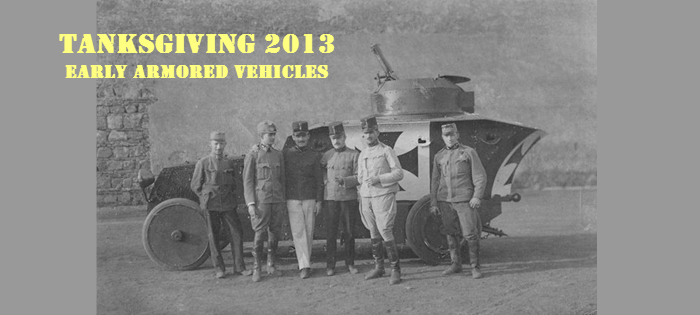
TANKSgiving 2013 – Early Tanks

GrogHeads TANKSgiving

Author: Lloyd Sabin, November 26, 2013

Very Early Armored Vehicles

It’s the most wonderful time of year! When else do we get to discuss the benefits of century old armored oddities? Probably all the time if you’re a grog, but this is more special because we say it is.

Early motorized vehicles are fascinating enough…apply an inch of armor plate and a gun turret and it’s a real party. The below vehicles are some of my new found favorites…each has that certain something and they all look to have stormed straight out of a steampunk imagination. So put on your goggles, put a rag over your face and let’s see what all the kids are screaming about when they discuss very early armored vehicles. At least my kids, anyway.

Romfell Armored Car

romfell_5The Romfell was built in Austria-Hungary around 1915. That gives it a slightly exotic air. In 1915 and 1916, only two existed, but they both survived the harsh conditions and combat in the Balkans against the Serbian Army, and went on to engage the Italians and Russians. That gives it a tough reputation. In 1917 dozens more were built and deployed, its successful combat record making it somewhat of a legend.

Each Romfell armored car had a crew of four, was powered by a Mercedes transmission and was armed with a Schwarloze machine gun that could be used against both air and ground targets.  Reliable and fast for the era with a 26mph top speed, the Romfell is a popular vehicle for modelers.

It’s hard not to be intrigued by the Romfell. It’s very modern look, pedigree and durability guarantee that historians or car aficionados will quickly fall in love.

Fowler B5 Armored Locomotive

Fowler B5Armored cars are one thing…armored trains are another.

Now don’t get the wrong idea, the Fowler B5 armored locomotive did not go into combat during the Boer War at high speed with guns blazing. It did, however, deliver heavy guns and supplies for the British Army against the Boers starting roughly towards the end of 1899.

To tow these guns, the Fowler factory in Leeds, UK, produced a handful of B5s with close to 125 horsepower! With that much strength, heavy slab armor was applied to the engines to protect them and their drivers from attacks by Boer raiders. Three or four of these heavy armored locomotives were used by the British during the Boer War, some with armored railroad cars as well.

Prototypes of gun carrying armored Fowler B5s were developed but as far as I could research, none were ever deployed in a combat role. It would have been quite the scene if they had been – there’s no telling how effective they would have been at fighting. For protecting and delivering heavy equipment and guns, though, they were very successful. Continue reading

08/23/13

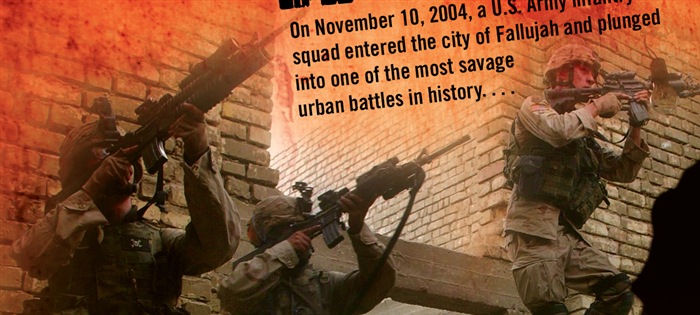
Book Review: House to House

“A riveting and sober account of war in all its horror and glory.”

Authors: SSG David Bellavia with John R. Bruning

Publisher: Pocket Star (Kindle eBook Edition Reviewed)

Reviewing Author: Jim Zabek

housetohousebigMany of the memoirs written by contemporary veterans have a predictable structure. This is especially true of the writings of elite troops such as Navy SEALs. They often open with a discussion of how difficult their training was. I believe many these accounts spend so much time focused on training not only because it is difficult and dramatic, but also because many of the operations the authors undertook aren’t declassified. It’s difficult to write a memoir about operations that aren’t supposed to have taken place.

SSG Bellavia’s book is different. He was a regular infantryman in the US Army. He allots most of his time not in avoiding his combat experiences, but rather in bringing them to the reader’s attention. In the Author’s Note he clarifies that some events have been slightly altered, either due to timing so that events can be better understood in context, or reconstructed as best he could when he wasn’t there to directly witness the action himself. The result is a riveting and sober account of war in all its horror and glory.
Continue reading

05/15/13

The Significance of Airpower

Author: Jim Zabek

Airpower in warfare has been employed for over a century. Examples of its use go back as far as the American Civil War, where hot air balloons were used for aerial reconnaissance. The First World War saw an expansion of role of aircraft, and the typical roles that aircraft play in combat were largely defined during that conflict. Fighters, bombers, interceptors, and reconnaissance aircraft all emerged during World War One. But it was during the Second World War that airpower evolved from being a part of combined arms operations to being a fully-fledged combat arm of its own, capable of tipping the scales of battle on its own.

Dauntless-at-midway
Continue reading